Your cart crawls up the hill it used to climb, the charger runs all night, and the counter is quoting numbers you have no way to check. Almost every electric cart runs on a pack of several batteries wired in series to make 36 or 48 volts, and two decisions follow from that: what fits, and lead-acid or lithium.
Golf Cart Batteries Explained: Voltages, Pack Layouts and What Fits Your Cart
On this page (5)
What voltage is my cart, and how many batteries?
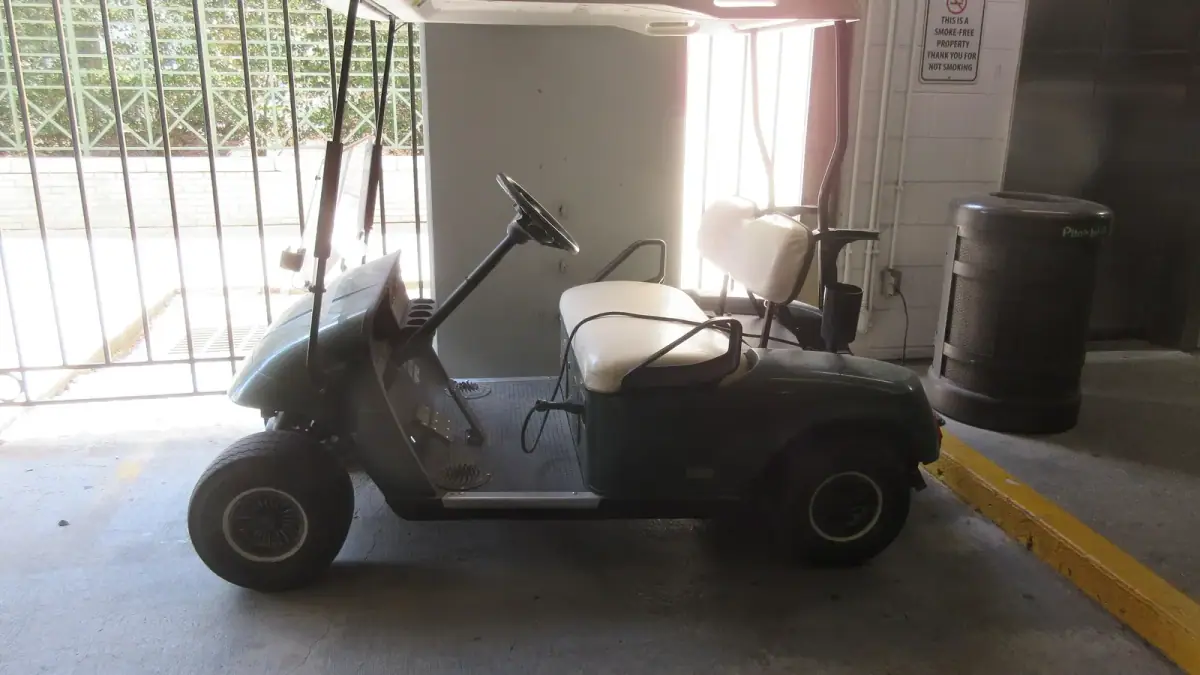
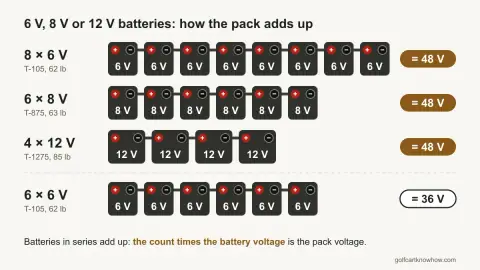
Your cart is a 36 volt or a 48 volt cart, and that total comes from several 6 V, 8 V or 12 V batteries joined in series under the seat. Lift the seat, count the batteries and read the voltage printed on the label of one of them: that pair of numbers is the figure every other decision rests on, and it is the one thing a parts counter will ask you first. How the units add up to a pack is set out on the page for 6 V, 8 V and 12 V golf cart batteries.
Worth knowing: Two carts can both be 48 volt carts and take completely different batteries. Six 8 V units, eight 6 V units and four 12 V units all reach 48 volts, and the layout under your seat, not the pack voltage, decides what fits in the tray.
Lead-acid or lithium?
Chemistry is a separate decision from fitment: you can usually replace a flooded lead-acid pack like for like, or move the cart to lithium, and the choice turns on cost over time, weight and how you charge. The money and the trade-offs are worked through on lithium vs lead-acid for golf carts, what comes in a kit on lithium conversion kits, and the charger question on whether lithium needs a new charger. Changing chemistry changes how the pack is charged and protected, so have a dealer or a qualified technician handle the conversion wiring.
What fits a Club Car, E-Z-GO or Yamaha?
Fitment follows the model and the year, not the badge. A Club Car Precedent is wired differently from a DS, and an E-Z-GO TXT came as both a 36 volt and a 48 volt cart depending on the year, so the model-by-year pages are where to check: which batteries fit a Club Car and E-Z-GO batteries. Once you know the size, the brand figures are on the makers' own sheets, such as Trojan Battery, summarized on the Trojan golf cart batteries page.
Worth knowing: Before you drive to the dealer, photograph three things with your phone: the label on one battery, the whole tray with the cables in place, and the label on your charger. That answers every question the counter will ask you.
How do I charge it and look after it?
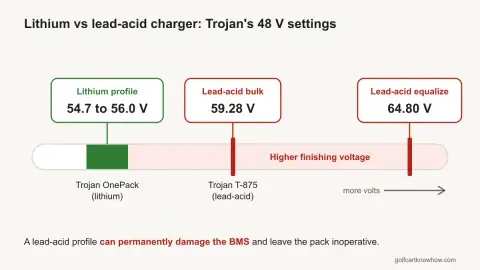
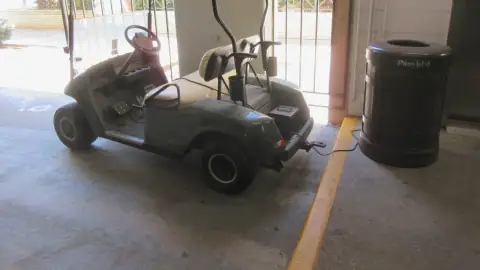
The charger has to match the pack: the same voltage, the right plug for your cart, and a profile made for your chemistry. Brand pages cover the differences: golf cart chargers in general, E-Z-GO chargers and Yamaha chargers, with the routine itself on how to charge a golf cart.
Care for a flooded lead-acid pack is short and seasonal:
- Monthly and yearly checks: golf cart battery maintenance
- Topping up the cells: watering golf cart batteries
- Judging a tired pack: how to test golf cart batteries and the battery checker
- Corroded or undersized leads: golf cart battery cables
- A charger that stays dark: golf cart charger not working
- Months in a cold garage: storing a golf cart for winter
How long should the pack last, and what will a new one cost?
Interstate puts a golf cart pack at three to five years, and the gap between those numbers is mostly charging habits, watering and how hard the cart works. Replacement is priced per battery, so the bill depends on how many your layout takes and which brand you buy, which is why the counter cannot quote you until you know the voltage and the count. The arithmetic is on how long golf cart batteries last and what a new set costs.
All guides in this section
-
 6 V, 8 V and 12 V Golf Cart Batteries: How They Add Up to a 36 V or 48 V Pack
Why some golf carts carry six 8-volt batteries and others eight 6-volt or four 12-volt, how the pack voltage adds up, and how to read your own layout.
-
 Do You Need a New Charger for Lithium Golf Cart Batteries?
Whether a lead-acid golf cart charger can charge a lithium pack, what the cart and pack makers require, which chargers can be reprogrammed, and the plug.
-
 E-Z-GO Golf Cart Chargers: Which Charger and Plug Your TXT or RXV Takes
Which charger an E-Z-GO TXT, RXV or ELiTE takes, the 2-pin and 3-pin plugs, what the charger lights and red flashes mean, and when to call a dealer.
-
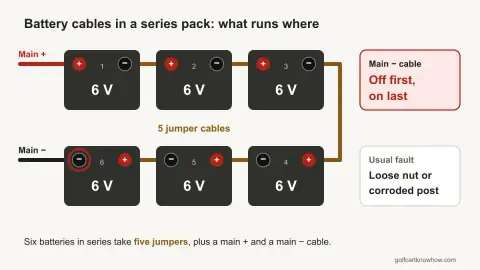 Golf Cart Battery Cables: Gauge, Length, Corrosion and Replacing Them
What gauge golf cart battery cables come in, what the amp ratings mean, why terminals corrode and melt, and the makers' order for taking cables off.
-
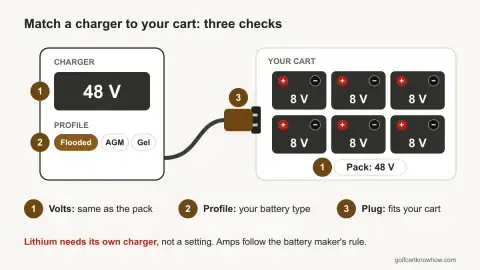 Golf Cart Battery Chargers Explained: Voltage, Amps and Plugs
How a golf cart battery charger is matched to your cart: pack voltage, amp rating, the plug on the cart, the battery type, and the outlet and cord rules.
-
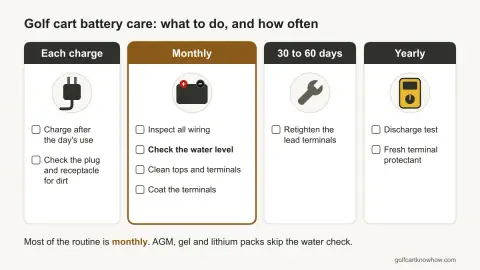 Golf Cart Battery Maintenance: What to Check Monthly and Once a Year
The battery checks the makers actually list: the monthly inspection, cleaning and terminal routine, the yearly test, and what changes for AGM and lithium.
-
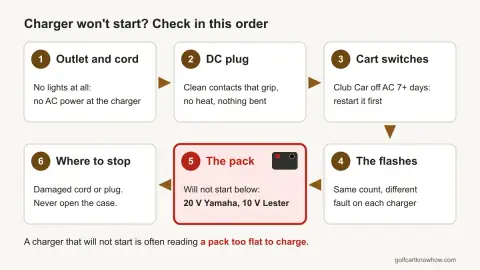 Golf Cart Charger Not Working: What to Check, in Order
A golf cart charger with no lights or a fault flash: outlet, plug, switch and battery checks in order, the lights by maker, and when to call service.
-
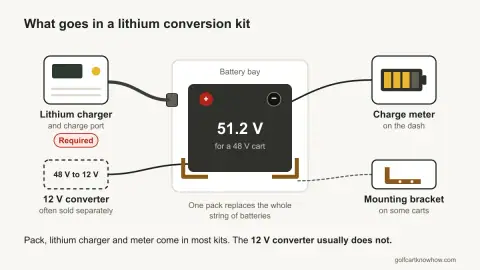 Golf Cart Lithium Conversion Kits: What Is in the Box and What Else on the Cart Changes
What each maker's lithium conversion bundle includes, how a pack is matched to your cart's voltage, what else on the cart changes, and the warranty terms.
-
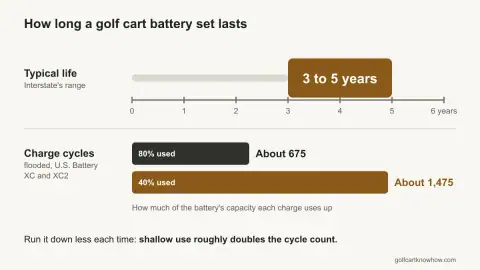 How Long Golf Cart Batteries Last and What a New Set Costs
What the battery makers actually say about lifespan, the signs a golf cart pack is done, what shortens its life, and the list price per battery.
-
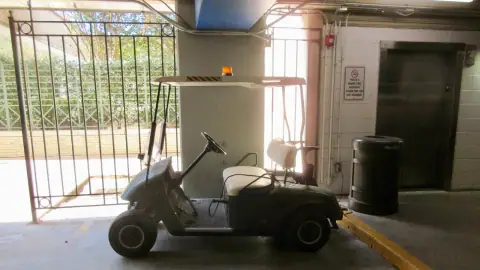 How to Charge a Golf Cart: The Steps, How Long It Takes and Leaving It Plugged In
How to charge a golf cart as the makers describe it: checks before plugging in, the steps by cart, how long it takes, when to plug in and leaving it on.
-
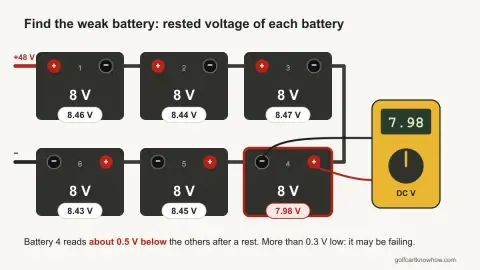 How to Test Golf Cart Batteries: Multimeter, Hydrometer and the Load Test
How to find the bad battery in a golf cart pack: a rested multimeter reading on each battery, a hydrometer for the weak cell, and when a load test is due.
-
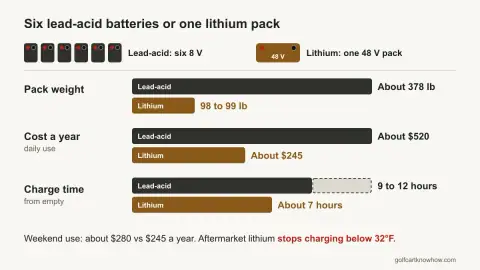 Lithium vs Lead-Acid Golf Cart Batteries: Cost Over Time, Range, Weight and Charging
Lithium and lead-acid golf cart batteries compared on the makers' figures: cycle life, usable capacity, weight, charging, and what a switch changes.
-
 Storing a Golf Cart for Winter: Batteries, Charger, Tow Switch and Tires
How the makers say to store an electric golf cart for winter: battery prep, plugged in or disconnected, the tow switch by cart, check intervals, lithium.
-
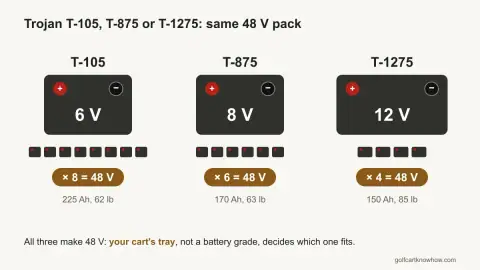 Trojan Golf Cart Batteries: T-105, T-875 and T-1275 on Trojan's Own Figures
Trojan's three golf cart batteries side by side from its own data sheets: voltage, group size, capacity, weight, Plus Series, HydroLink and the warranty.
-
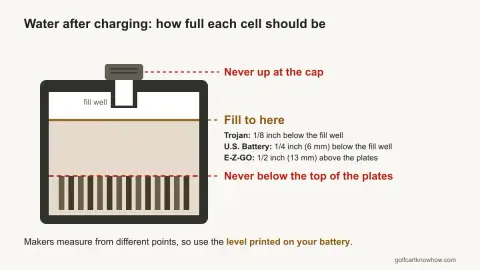 Watering Golf Cart Batteries: How Often, How Full and Which Water
When to add water to flooded golf cart batteries, how full each battery maker says to fill the cells, which water is allowed, and how to do it safely.
-
 Which Batteries Fit an E-Z-GO: TXT, TXT 48, RXV and ELiTE by Pack Voltage
The battery layout of the E-Z-GO TXT, TXT 48, RXV and ELiTE, how to tell which voltage yours is, the battery sizes that fit, and the lithium options.
-
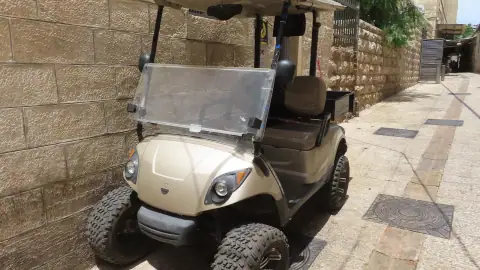 Yamaha Golf Cart Chargers: The 48 Volt Charger, Plugs and Amps for the Drive and Drive2
Which charger a Yamaha Drive, Drive2 or older G-series takes, the plug on each, why lithium and lead-acid chargers differ, and what the lights mean.