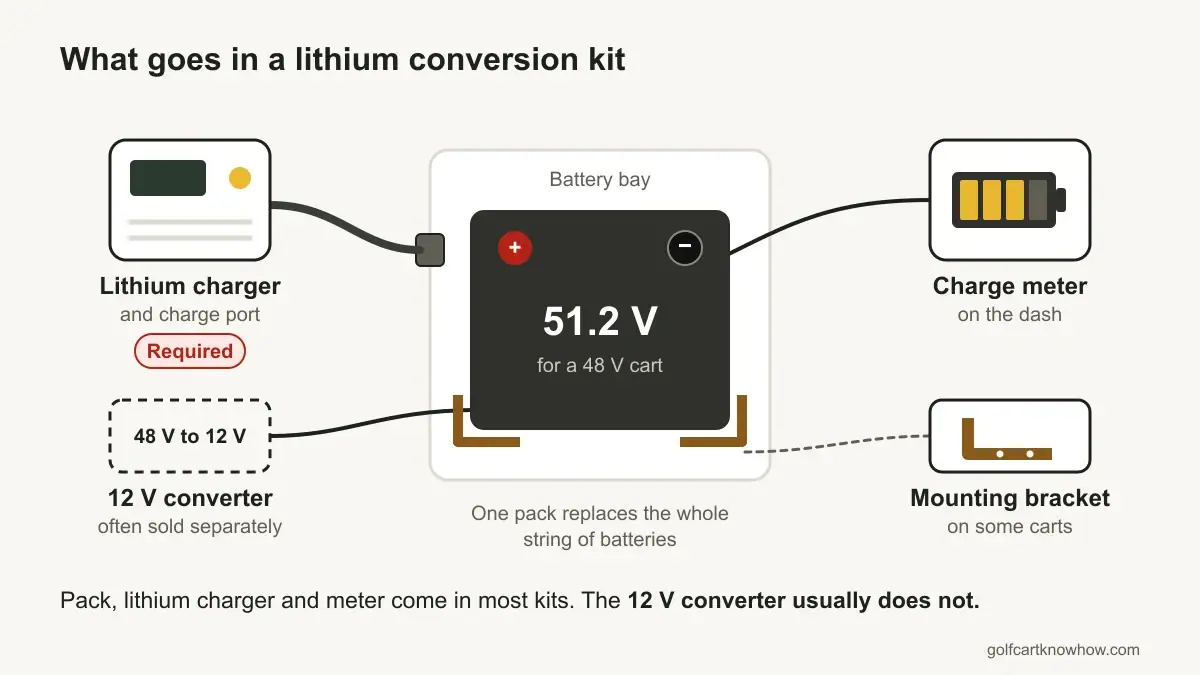
You have decided on lithium, and every kit you price up seems to hold something different. There is no standard one. Each pack maker sells its own bundle: one pack in place of the old batteries, a lithium charger, a charge meter, then brackets, a charge port or a converter for your 12 volt lights, depending on your cart.
Golf Cart Lithium Conversion Kits: What Is in the Box and What Else on the Cart Changes
Some links on this site are affiliate links: if you buy through them we earn a commission, at no extra cost to you. As an Amazon Associate we earn from qualifying purchases.
At a glance
- Always in the box: the pack, and in most bundles a lithium charger and a state-of-charge meter; brackets and a charge port vary by maker and cart.
- The part people forget: 12 V lights and accessories need a DC-to-DC converter, which several makers sell separately.
- The warranty hangs on two things: registering the pack in time, and charging it with the maker's own lithium charger.
On this page (6)
What comes in a lithium conversion kit?
Eco Battery and Allied list the most parts, Trojan sells a bundle alongside the bare pack, Dakota Lithium sells a battery and no cart hardware, and ROYPOW publishes no packing list at all.
| Maker | What the bundle lists | Separate or not listed |
|---|---|---|
| Eco Battery | Battery, charger, CAN battery meter, a charge port for your cart, plus a mounting bracket on the RXV and Yamaha Drive bundles | 12 V converter, called optional in the install guides |
| Allied, Commercial package | Battery, waterproof charger, mounting brackets and hardware, installation cables, state-of-charge meter, terminal protectors, Bluetooth | 12 V step-down converter |
| Trojan, OnePack bundle | Pack, dashboard gauge kit and power button, charger kit, battery mounting kit, AC plug adapter | The pack is also sold on its own |
| Dakota Lithium | Battery with a built-in display | Charger recommended; no brackets, cables or converter |
| ROYPOW | Its guides say a kit should hold the pack, a lithium charger, an onboard-computer bypass harness for a Club Car Precedent or later DS, mounting hardware, cables and a charge gauge | A 12 V reducer on a Yamaha |
Read the order page, not the package name: Allied's Precedent drop-in listing shows the charger, meter and converter as separate accessories. Whether the swap pays back over the years you keep the cart is a separate question, answered on lithium against lead-acid.
Which kit matches your cart: 36 V or 48 V?
Buy the pack for your cart's system voltage. Allied's quickstart tells you to confirm the battery matches your motor and controller voltage, and Trojan's guide says to verify the voltage suits the motor controller and the accessories. If you do not know which you have, read the labels on the batteries under the seat, or check which batteries fit an E-Z-GO by model and year.
A lithium iron phosphate (LiFePO4) pack prints a higher number than the cart's name: a 51.2 V pack is the one for a 48 V cart, and Trojan's 36 V OnePack prints 38.4 V. Eco simply calls its packs 38V and 51V.
One pack replaces the whole series string. Allied says never to connect its batteries in series, and Trojan says not to connect its packs in series or parallel, so the jumper cables between the old batteries come out and do not go back. Trojan lists its 36 V OnePack for legacy and refurbished carts.
What else on the cart has to change
- 12 V lights, horn and stereo: these run through a DC-to-DC converter, never off the pack terminals. Allied, Trojan and Eco all say so, and E-Z-GO says the same on its own 48 V and lithium carts. The part is a Pro Chaser 36 V / 48 V to 12 V 30 A step-down converter or the maker's own.
- Mounting: brackets are cart-specific. Eco's RXV guide has you drill the battery tray; its Precedent guide reuses the cart's own J-hooks; ROYPOW says a Precedent's tub dividers come out, while a Yamaha Drive tray takes a single pack with little adapter hardware.
- The dash meter: Eco's gauge flush-mounts in a 2-1/16 in. hole, on an optional bracket or on the steering column. Trojan's gauge wires straight to the battery rather than through the key switch.
- The charge port: Eco's TXT and RXV kits fit their own port and deal with the factory port's drive-off safety wire. Trojan's charger brings a two-wire interlock cable that connects to the cart.
- Cables: Eco recommends heavier cables for bigger tires, extra seats or a higher-amp controller; Allied says buy longer ones if the supplied pair will not reach.
- The charger: Eco, Allied and Trojan each require their own, so the old lead-acid charger does not go back on. Dakota is the outlier, saying a lead-acid charger works but only to 80 percent of capacity.
Tip: The 16 V to 12 V reducer already on many lead-acid carts taps two batteries in the string (its installation sheet has you confirm 16 volts with a meter). One pack has no mid-string tap, so the lights need a full-pack converter instead.
Club Car Precedent and E-Z-GO RXV: where the makers disagree
On a Precedent the pack makers contradict each other. Eco Battery's FAQ says no onboard-computer bypass is needed when you use the Eco charger. ROYPOW says the onboard computer must be bypassed with a jumper harness, and that the factory-lithium Tempo and Onward need a pack that speaks the cart's CAN bus or an aftermarket controller such as a Navitas system. The packs sold for a Club Car differ by year on exactly this point.
On an RXV, which brakes regeneratively, Allied says no extra resistor coil is required, while ROYPOW tells buyers to check that the pack's BMS accepts power coming back from regeneration. Trojan lists its 48 V OnePack as a drop-in for the RXV Gen 1 ELiTE with the stock motor and controller, Gen 1 being the pack makers' label rather than E-Z-GO's.
So before you order, ask the pack maker in writing whether the kit fits your model and year, and keep the reply.
Installing it yourself, and what it does to the warranty
Eco's install guides say they are not meant to give an untrained person enough knowledge to work on lithium or electric-vehicle systems, that you should stop and seek professional installation if any step is unclear, and that damage from a bad install is not covered. The RXV job is not only a battery swap: the seat, both rocker panels, the floor mat, the cup holders and the four dash bolts come off to route the meter and charge-port wiring. A conversion rewires the charging system, so if any of that is unclear, hand it to a technician.
| Maker | Register within | Charger condition | Other condition |
|---|---|---|---|
| Eco Battery | 60 days, or a 1-year limited warranty | Eco charger; a third-party charger voids it | Install damage not covered |
| Allied, Commercial RS | 60 days, or one year | Allied lithium charger only | Fully charged within 2 months of receipt, then at least every 3 months |
| Trojan OnePack | 90 days, or one year | A charger in Trojan's compatibility guide | No series or parallel wiring, no altered BMS |
Allied's non-RS lines ask for registration within 30 days and a full charge within 3 months of receipt. On the cart's own warranty, E-Z-GO says to use OEM approved parts to keep the vehicle warranty effective, and Club Car's warranty does not apply to a product altered to change its operation, performance or intended use, and does not cover parts that are not original equipment.
Tip: Trojan's guide warns that a light, USB charger, voltage reducer or GPS left connected can drive the pack into a low-voltage fault, and that a battery left there can become unrecoverable. Everything except the charge gauge should run through the cart's on/off switch.
Common questions
Do I need to reprogram my cart's controller for lithium?
Not for the pack to work: Trojan's OnePack guide says the CAN bus feature is not required for normal operation and the battery protects itself autonomously. Where a controller does talk to the pack, integration may need a vehicle-specific update, and Trojan's packs are selectable by name in the Navitas Dashboard App.
Does a new lithium battery meter need setting up?
Eco's install guide says to fully charge the pack before any extended driving, after which the LCD meter self-calibrates to 100 percent, and that the pack's power button must be on while charging and discharging. Allied's meter plugs into the port labelled SOC METER and may read slightly lower than its app.
Can a lithium pack shut the cart off without warning?
Trojan's guide says yes: a lithium pack may disconnect from the host system without warning, which means total power loss. The causes it lists are high voltage from a charger or regenerative braking, low voltage or low state of charge, high current, an external short, and high or low temperatures.