Club Car, E-Z-GO and Yamaha are the three long-established golf cart makers this guide starts with. A handful of newer makers sell lithium carts alongside them. The number on your cart's frame or dash tells you the model and year, and every part you buy follows from it.
Golf Cart Brands and Models: Club Car, E-Z-GO, Yamaha and the New Makers, and How to Tell What You Have
On this page (7)
Club Car, E-Z-GO or Yamaha: which one is yours
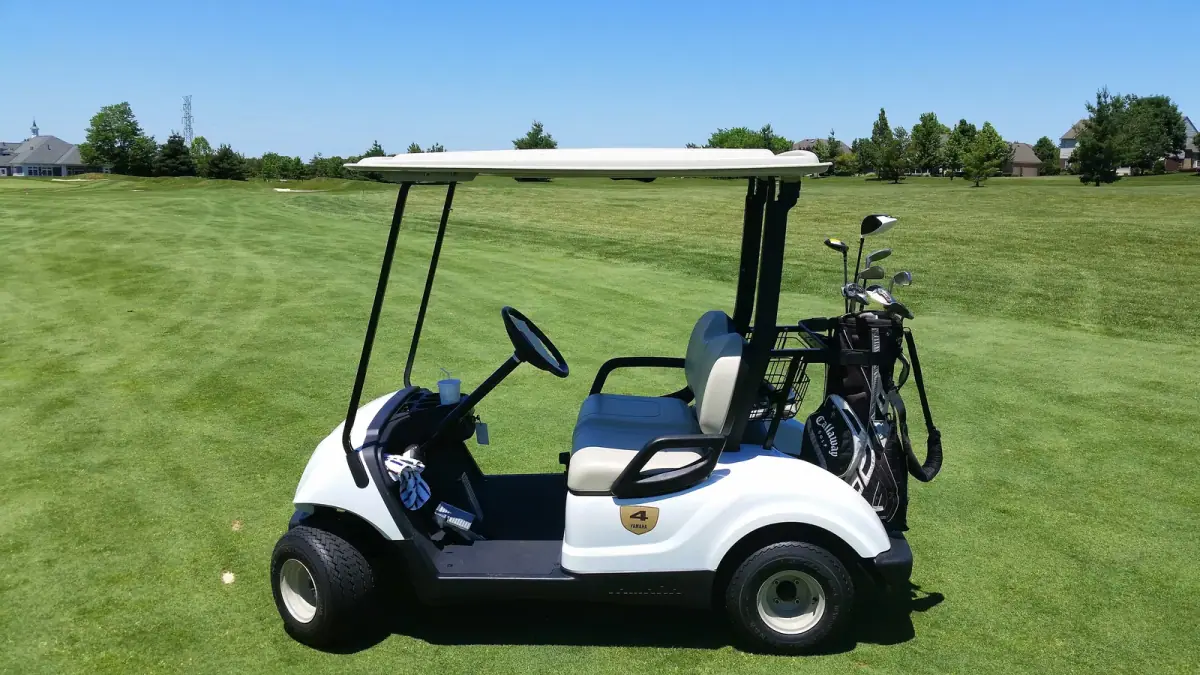
Club Car's golf cart lines are the DS, the Precedent, the Onward and the Tempo; E-Z-GO's are the TXT and the RXV; Yamaha's are the G-series, the Drive and the Drive2.
| Maker | Golf cart lines | Years the maker prints | Where the number is |
|---|---|---|---|
| Club Car | DS, Precedent, Onward, Tempo | DS 1980 to 2014, Precedent from 2004, Onward from 2017 | Bar code decal below the passenger side cup holder or above the pedals |
| E-Z-GO | TXT, RXV | TXT guides from model year 2014; RXV platform from 2008 | Steering column or below the driver side seat on carts bought before 2023 |
| Yamaha | G-series, Drive, Drive2 | Drive manuals through 2016, Drive2 from 2017 | Plate shown in the owner's manual, with a second label for the year |
E-Z-GO's Express is its shuttle and utility line, marked off-road use only in its own manual, not a golf cart line.
Reading the number to get the model and year
Club Car's own FAQ says the letter or letters start the model and the next four digits give the model year and production week. E-Z-GO points owners to the barcode on the steering column or under the driver seat. Yamaha's Drive2 manual says the first three digits identify the model. Read the decal on your own cart first, then let the brand guide decode it, as E-Z-GO's models by year does.
Tip: Club Car's online serial prefix directory returns the model name only. One row carries a year range. The year lives in the four digits after the prefix, so a prefix lookup alone will not date your cart.
The newer makers: Evolution, ICON and Kandi
These three sell lithium carts built around one pack instead of six batteries. Evolution puts its serial number on the left side of the chassis frame, behind the driver side front wheel. ICON has sold carts since 2017 and treats Eco Battery as its only approved lithium pack. Kandi stamps a VIN on the front beam of the frame. Evolution and ICON both say a 17-character VIN belongs to a low speed vehicle rather than a golf cart; Kandi prints a frame VIN on its carts either way.
Tip: Evolution's Classic Series manual says the first four numbers are the build year, with 202189XXX as its example. Its support page says four letters instead, so trust the manual and the first four characters.
Voltage and battery layout
- Club Car: the Precedent is a 48 V system. Cable sellers list four 12 V batteries on 2004 to 2008 cars and six 8 V from 2008.5 up, but U.S. Battery lists six 8 V for Precedent models and four 12 V only for the Precedent Champion, so count the batteries under your seat; a gas car carries one 12 V battery.
- E-Z-GO: the current TXT guide covers a 48 V electric car, and the RXV ELiTE manual lists a 48 V primary system with a single lithium module, 56.7 V at its maximum, that accepts only its approved charger.
- Yamaha: the G16E took six 6 V batteries for 36 V; the G19E and G22E take six 8 V batteries (BCI group GC-2H); the Drive and Drive2 specify six 8 V Trojan T-875, and the lithium Drive2 is a 48 V system with a 51 V, 5.3 kWh RoyPow pack, per Yamaha's 2025 manual.
What each line is known for, and what to watch
Club Car credits the DS with durability and ease of maintenance, and the one-millionth vehicle it built was a DS; the Precedent i2 arrived in 2004 and the Onward in 2017 as the customizable personal line. The TXT is E-Z-GO's fleet cart, and the guide E-Z-GO still publishes starts at model year 2014; the RXV carries E-Z-GO's AC drive with a parking brake that engages whenever the cart stops. Yamaha's Drive and Drive2 are sold on independent suspension and quiet powertrains. Each brand guide carries the failure points and recalls for its own models.
What fits it
Fitment splits by model, model year and drive system, so an RXV takes different brake and drive parts than a TXT of the same age. Match batteries, chargers, tires, wheels and lift kits to the model and year off the decal, not to the brand name alone. Battery fitment, tires, wheels, lift kits and the rest of the upgrade list each have their own page on this site.
Gas or electric, new or used
A gas cart runs an engine and one 12 V starting battery, so it refuels in a minute and has no pack to replace. An electric cart is quieter and cheaper to run, but its value rests on the pack: lead acid needs watering, lithium does not. New prices rise with seat count, lift, lithium and a street-legal package, which adds a VIN and a 25 mph speed cap under the federal low speed vehicle rules. On a used cart, the remaining pack life and the model year decide the price.
All guides in this section
-
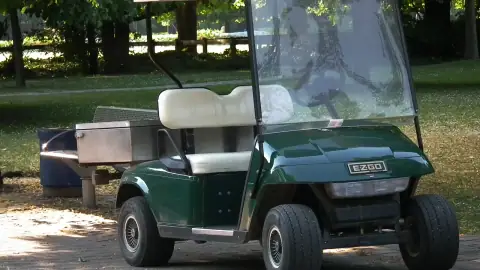 E-Z-GO Golf Carts by Year: TXT, RXV and the Older Models
Every common E-Z-GO model by year, the voltage and drive system of each, how to read the serial number, and what each model is known for.
-
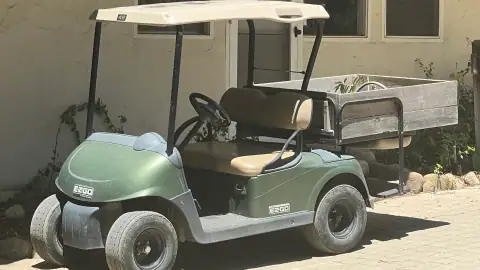 E-Z-GO RXV by Year: the Versions, the AC Drive, Recalls and What Fits
Which E-Z-GO RXV you have and its year, what the AC drive and automatic parking brake mean for an owner, the recalls to check, and the parts that fit.
-
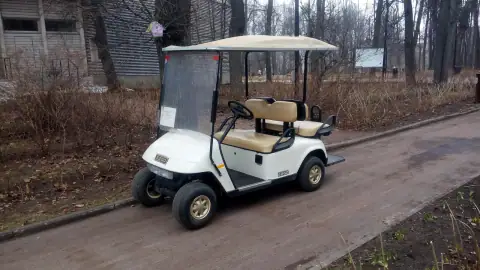 E-Z-GO TXT by Year: the 36V and 48V Versions, Recalls and What Fits
Which E-Z-GO TXT you have and its year, how to tell a 36 volt from a 48 volt cart, the recalls to check on a used one, and the parts that fit.
-
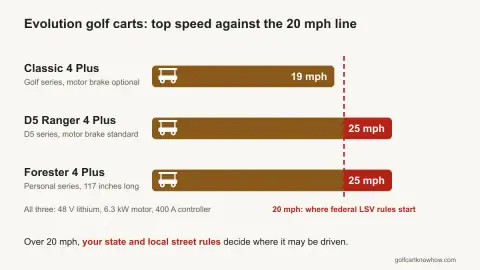 Evolution Golf Carts: the Models, the Lithium Packs and What the Warranty Covers
Evolution golf carts from the maker's own documents: the model lines, the lithium packs and charger, how to find the year, and the warranty terms.
-
 Golf Cart Dimensions by Model: Length, Width and Height
Length, width and height of current E-Z-GO, Club Car, Yamaha, Kandi and ICON carts as the makers print them, and how to check garage and trailer fit.
-
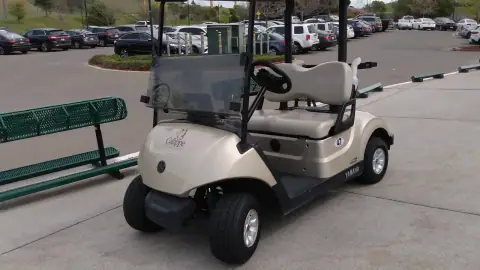 Yamaha Golf Carts by Model and Year: the G-Series, the Drive and the Drive2
Every common Yamaha golf cart from the G1 to the Drive2, the voltage and power of each, how to find the model and year, and what each line is known for.