You plugged the cart in last night and woke up to a dark charger, or a light blinking red and no charge. Most of the time nothing inside the charger has failed: the outlet is dead, the plug is not gripping, a switch is in the wrong place, or the pack is too flat for the charger to see it.
Golf Cart Charger Not Working: What to Check, in Order
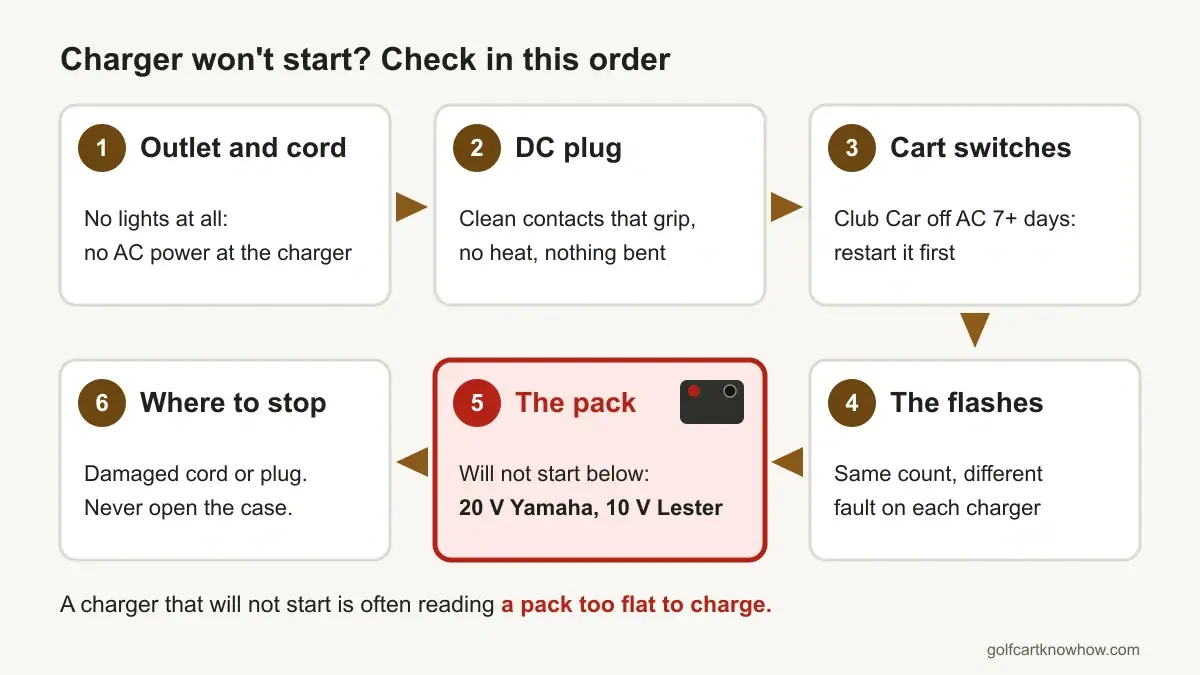
At a glance
- Check in order: outlet and cord, then the DC plug, then the cart's switches, then the light, then the pack.
- Flash codes are not universal: the same count means different things on E-Z-GO, Yamaha, Delta-Q and Lester chargers.
- A dead-flat or sleeping pack stops many chargers from starting at all, which looks exactly like a broken charger.
On this page (6)
What to check, and in what order
Work outward from the wall, the way the makers' own troubleshooting tables do.
- The outlet and the AC cord. If no LED lights or blinks at all when the AC cord goes in, Yamaha says no AC power is reaching the charger: confirm voltage at the outlet, check the cord connections, replace a damaged cord. Charger output follows input voltage, so a long extension cord or a weak circuit shows up as a charge that never finishes.
- The DC plug and the cart's receptacle. One red flash on an E-Z-GO PowerWise QE means poor contact in the DC connector, or a battery too hot or too cold. Yamaha says not to use the charger at all if the receptacle no longer grips the plug tightly, the plug runs hotter than normal, or the contacts look bent, corroded, dark or bluish.
- The cart's switches. On a flooded-battery Yamaha the tow switch goes to TOW before you plug in; on the lithium Drive2, TOW goes on after the DC plug is in, and Yamaha warns of electrical system damage either way if the order is wrong. An E-Z-GO that still drives while the DC plug is in is not charging at all: the PowerWise QE 48 V manual says the vehicle is locked out of operation while it is plugged in. A Club Car with an on-board computer that has been without AC for seven days or more will not charge until you restore power, pull the cord, wait five seconds and reconnect.
- The light. Read it against your own charger's table, next section.
- The pack. A pack that is too flat, failed or asleep can stop the charge before it starts.
What the flashing lights mean on your charger
Count the flashes between pauses, then find your charger and the document its codes come from. A FORM Charge unit whose light does not change when you plug into the cart is not sensing the batteries at all, which points back at the receptacle.
| Charger and document | What you see | What it means | What to do |
|---|---|---|---|
| E-Z-GO PowerWise QE manual 710-0035 / TXT 48 guide 633137-D | Red on briefly, then nothing | No valid AC voltage | Check the outlet and cord |
| E-Z-GO PowerWise QE manual 710-0035 / TXT 48 guide 633137-D | 1 red flash | Poor DC contact, or battery above 122°F (50°C) or below 14°F (-10°C) | Clean and reseat the plug; let the pack reach normal temperature |
| E-Z-GO PowerWise QE manual 710-0035 / TXT 48 guide 633137-D | 2 red flashes | Pack voltage out of range, above 67.2 V or too low | Test the pack |
| E-Z-GO PowerWise QE manual 710-0035 / TXT 48 guide 633137-D | 3 or 4 red flashes | Charge timed out, or the pack never reached its nominal voltage | Suspect a tired or failing battery |
| E-Z-GO PowerWise QE manual 710-0035 | 6 red flashes | Internal charger fault | Unplug and replug the DC cord; if it returns, qualified service center |
| Delta-Q QuiQ guide in the RXV ELiTE manual 10036459-D | Amber AC light flashing | Low AC voltage | Check the source and extension cord length |
| Delta-Q QuiQ guide in the RXV ELiTE manual 10036459-D | Red fault light flashing | Wake-up pulse, timeout, BMS fault, over-temperature or internal fault | Reset AC power; a BMS or timeout fault goes to the service department |
| Delta-Q RC900 guide in the RXV ELiTE manual 10036459-D | Off / rapid amber / solid red | No AC / error / fault | Replug; if it stays, a qualified technician |
| Yamaha Drive2 2019 and 2025 manuals | Red flashes, counted | High or low battery voltage, timeout, check battery or no BMS communication, over-temperature, internal fault | Reset 15 seconds; service technician if it persists |
| Lester Summit Series II manual | Red, yellow, green combinations | Profile mismatch, no AC, low temperature, minimum voltage not met, max time, battery fault, hardware fault | Disconnect from the battery to clear; hardware fault goes to Lester |
| Club Car E.R.I.C. sell sheet | Orange triangle flashing / red lit | Charge not completed / charger error | Red means unplug and reset |
| Eco Battery charger manual | Alternating green and red | A fault | Stop and check the connection and battery |
| Allied lithium FAQ | Green to red at the end of a charge | Cell balancing, not a fault | Leave it plugged in until green holds 3 minutes |
E-Z-GO's own documents disagree on codes 2 and 3 for the same PowerWise charger: the TXT 48 owner's guide prints a pack below 48.0 V and a 24-hour timeout, the PowerWise QE charger manual 36.0 V and 12 hours. Either way the pack is out of range or took too long. Which charger you have is on the label; E-Z-GO's charger range and Yamaha's are covered on their own pages, as are plug types and amp ratings.
Is it the charger or the batteries?
A pack can be too flat to wake the charger. E-Z-GO says a severely deep-cycled pack may not activate the charger's electronic module at all. Yamaha's charger will not start below 20 V on the pack; Lester's stops below 10 V. U.S. Battery puts the threshold at about 1 V per cell and says a separate manual charger may be needed to bring the batteries back up. No cart maker prints that step, so treat it as a last resort before replacement.
If the charger does run, Trojan's on-charge check tells you which side is weak: restart the charger, then read current and pack voltage in the last half hour. On a 48 V system, finishing below 56 V means check the charger's output and recharge; still low afterwards points to a failed battery. The TXT 48 guide calls a hydrometer the cost-effective way to find the one battery in the set reading a lower than normal specific gravity. Testing the pack properly is its own job.
Lithium behaves differently. An Eco battery has to be powered on, with its button lit, and Power Save mode shuts it down until you press the wake button. Allied packs sleep after about seven days. A Trojan OnePack at 0 percent needs the switch on the battery itself, not the dash button, and stays awake 5 minutes to let the charge start. Dakota Lithium says its own 48 V charger restarts a BMS that has switched a battery off, and FORM Charge's manual has a Force Start for a battery below normal starting voltage: hold MODE SELECTION 5 seconds for a 2 A forced charge.
Tip: A lithium cart that sat through a cold snap is not broken. Eco and Trojan both block charging below 32°F (0°C) to stop lithium plating inside the cells. Move the cart somewhere warmer and try again before you buy anything.
Resets, long charges and charges that quit early
Each maker clears a fault its own way: E-Z-GO, unplug the DC cord from the cart; Yamaha, DC or AC off for 15 seconds; ELiTE chargers, AC off 15 seconds or more; Delta-Q QuiQ, AC off 30 seconds; Lester, disconnect from the battery; a Club Car on-board computer, five seconds.
- Runs on and on: an over-discharged pack, low AC voltage, heat or blocked airflow around the charger, or a pack with more capacity than the charger was sized for.
- Past 20 hours: Yamaha says the charger may be boosting; look for the green 100 percent light blinking.
- Quits early: AC or DC interrupted mid-cycle, or a sulfated battery from a cart that sits unused.
- Starts by itself after a couple of weeks: a QuiQ in maintenance mode, which restarts after 14 or 30 days.
- Heavy watering or a rotten-egg smell: overcharging, often the wrong charge profile after a new pack went in.
Where to stop
Do not open the charger. E-Z-GO, Lester, FORM Charge and Eco all say the same thing: high voltage inside, and incorrect reassembly risks explosion, shock or fire. Six red flashes that come back after a DC replug means a qualified service center. Yamaha says call a service technician if the problem persists; an ELiTE fault that returns goes to E-Z-GO Customer Care; Club Car assigns charger repair to trained technicians only. A damaged cord, plug or receptacle takes the charger out of service until it is replaced.
Tip: Disconnect both AC and DC before cleaning anything, and pull the AC cord before the DC plug, never the DC plug mid-charge, because of the arc. Keep flooded batteries charging in a space with at least five air changes an hour.
Club Car faults beyond the computer restart and the E.R.I.C. lamps are not covered here. Charge times and leaving it plugged in are a separate question.
Common questions
Can you charge an 8 volt golf cart battery with a 12 volt charger?
No. Delta-Q's guidance for reviving individual batteries is to set the charger to the battery's own voltage: 6 V for a 6 V battery, 12 V for a 12 V battery. A 12 V charger is the wrong setting for an 8 V battery.
Why does my golf cart charger click on and off?
On a Delta-Q QuiQ, an AC light that is lit while the charger never starts means it has detected a condition that does not allow charging. Delta-Q says that is generally corrected by removing AC power for 30 seconds and reconnecting.
Why will my golf cart charger not work in the cold?
On a lead-acid E-Z-GO, one red flash can mean the battery is below 14°F (-10°C). A Lester charger has its own printed limit in the Summit Series II manual: it will not start a cycle below -13°F (-25°C), and starts once the temperature rises.