Your cart used to make it up the hill to the clubhouse and now it crawls, so you are wondering whether the pack is just old. No battery maker promises a number of years. How deep you run the pack down, how you charge it, the heat it lives in and whether the water was kept up decide it, and the signs tell you more than the calendar.
How Long Golf Cart Batteries Last and What a New Set Costs
At a glance
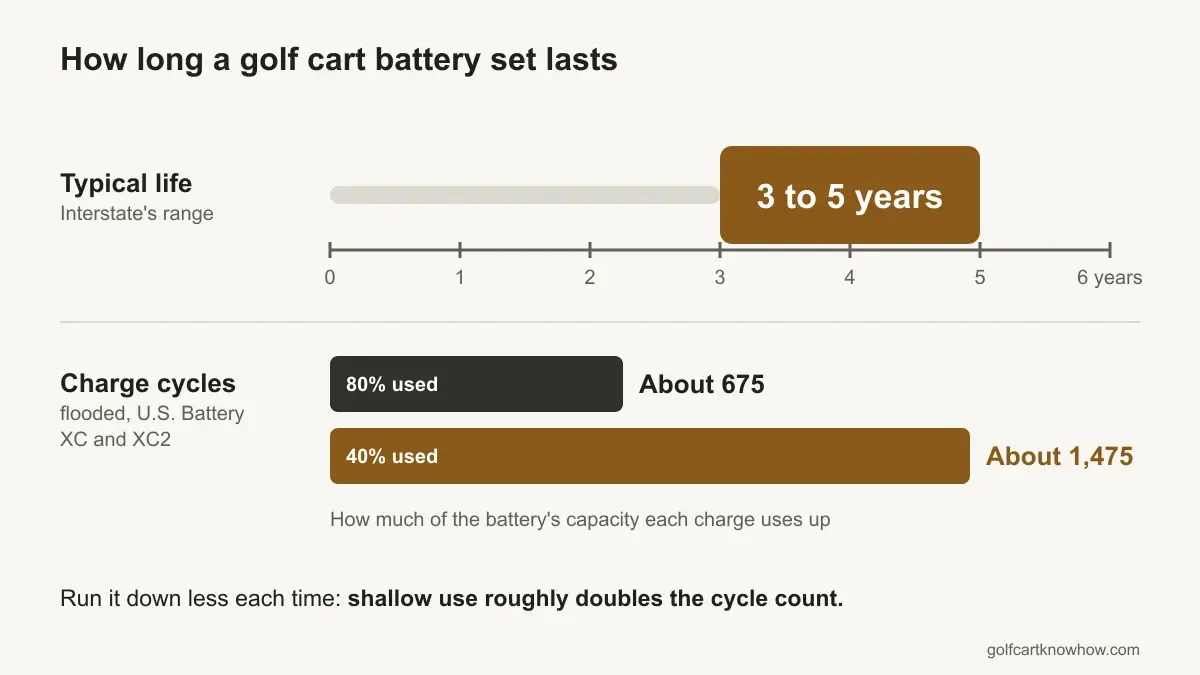
- Typical life: Interstate prints 3 to 5 years; the other makers print no year figure at all.
- What really sets it: shallow discharges roughly double the cycles a flooded battery gives.
- Cost: a six-battery 8 V set runs $1,410 at list, before installation.
On this page (5)
How many years do golf cart batteries last?
The number you will see everywhere comes from one maker. Interstate Batteries says golf cart batteries typically last 3 to 5 years, on a page that sells both flooded and lithium batteries and does not separate them. Trojan, U.S. Battery and Crown print no year figure, because life depends on how the pack is sized, how deep it is discharged, the loads, the maintenance, the temperature, the charger's algorithm and, U.S. Battery adds, the purity of the water you top up with.
The figure that does exist is cycles. U.S. Battery's chart for its flooded XC and XC2 line gives about 675 cycles when the battery is discharged to 80 percent of its 20-hour capacity, and about 1,475 cycles at 40 percent. Trojan prints no such curve for the T-105, T-875 or T-1275. Lithium packs are rated differently, and the lithium versus lead-acid comparison covers their life and price.
Worth knowing: Warranty is a defect floor, not a rated life. Trojan covers the T-105, T-875 and T-1275 for 18 months, Interstate mostly 12 (6 on one High Cycle GC2), and Club Car covers a flooded Onward pack for the earlier of 2 years or 23,000 hours. A pack that dies in year three is out of warranty everywhere.
How do I know mine are at the end?
Watch for these, in the makers' own terms:
- A rapid voltage drop under load, so the cart feels sluggish (Interstate)
- Much shorter range, slower acceleration, or trouble climbing hills
- Needing to add water every few weeks
- Longer-than-usual charging times
- Leaking acid or a swollen case: replace that battery
- Capacity down to about half, which is where U.S. Battery recommends replacement
- Brown or gray electrolyte, or a hydrometer spread of fifty points between cells (E-Z-GO TXT guide)
To put numbers on it rather than guess, test the pack with a multimeter, hydrometer and load test. If the cart will not move at all, that is a different fault to chase first.
What makes them last longer or die sooner?
How deep you run it down. Trojan's maintenance guide recommends 50 percent or less and calls 80 percent the maximum safe discharge; its FAQ puts the sweet spot at 20 to 50 percent. That one habit is the difference between the two cycle counts above.
Charging after every period of use. Lead-acid has no memory, so there is nothing to gain by running it flat first. Undercharging stratifies the electrolyte and leads to premature failure; overcharging gasses the battery and heats it. The charging routine and winter storage have their own pages.
Heat. Trojan states that for every 18°F (10°C) above 77°F (25°C), battery life drops by half. In Florida or Arizona, a garage that bakes all summer costs you more than the brand on the label.
Water level and purity. U.S. Battery lists it among the life factors, and Trojan's warranty excludes neglect such as improper fluid levels, so getting the watering right protects both the pack and the claim.
What does a new set cost?
Among the big flooded makers, only Interstate publishes list prices on its own site, per battery, read October 2026. Trojan, U.S. Battery and Crown sell through dealers and publish none.
| Battery | Group size | Capacity (20 hr) | List price |
|---|---|---|---|
| M-GC2-UTL | GC2 (6 V) | 210 Ah | $179.95 |
| GC2-ECL-UTL | GC2 (6 V) | 225 Ah | $214.95 |
| GC2HC-UTL | GC2 (6 V) | 240 Ah | $249.95 |
| M-GC8-UTL | GC8 (8 V) | 160 Ah | $209.95 |
| GC8-HCL-UTL | GC8 (8 V) | 170 Ah | $234.95 |
| GC12-HCL-UTL | GC12 (12 V) | 150 Ah | $374.95 |
Interstate suggested retail prices, read 14 October 2026; dealers set their own.
Multiply by your battery count. A 48 V cart on six 8 V batteries takes six GC8-HCL-UTL: six times $234.95 is $1,410 (calculated), before installation, cables and any core charge. Whether yours is six, eight or four is on the pack layout page, or on the labels under your seat.
Worth knowing: Replace the whole set, never one battery. Trojan and Crown both say so, because a new battery is dragged down to the condition of the old ones around it. E-Z-GO allows one exception: a single weak battery found by hydrometer may be swapped for one of the same brand, type and approximate age.
Common questions
Do golf cart batteries go bad if the cart sits unused?
Yes. Trojan says periods of inactivity can be extremely harmful to lead-acid batteries, and that flooded batteries self-discharge up to 15 percent per month at 77°F (25°C). Charge the pack completely before storing it, and do not leave it sitting discharged for months.
Does the battery warranty replace a worn-out set?
No. These warranties cover defects in material and workmanship, not normal wear, and Trojan excludes neglect such as improper fluid levels. A flooded pack that gradually lost capacity over three or four years is a worn-out set, not a defective one.