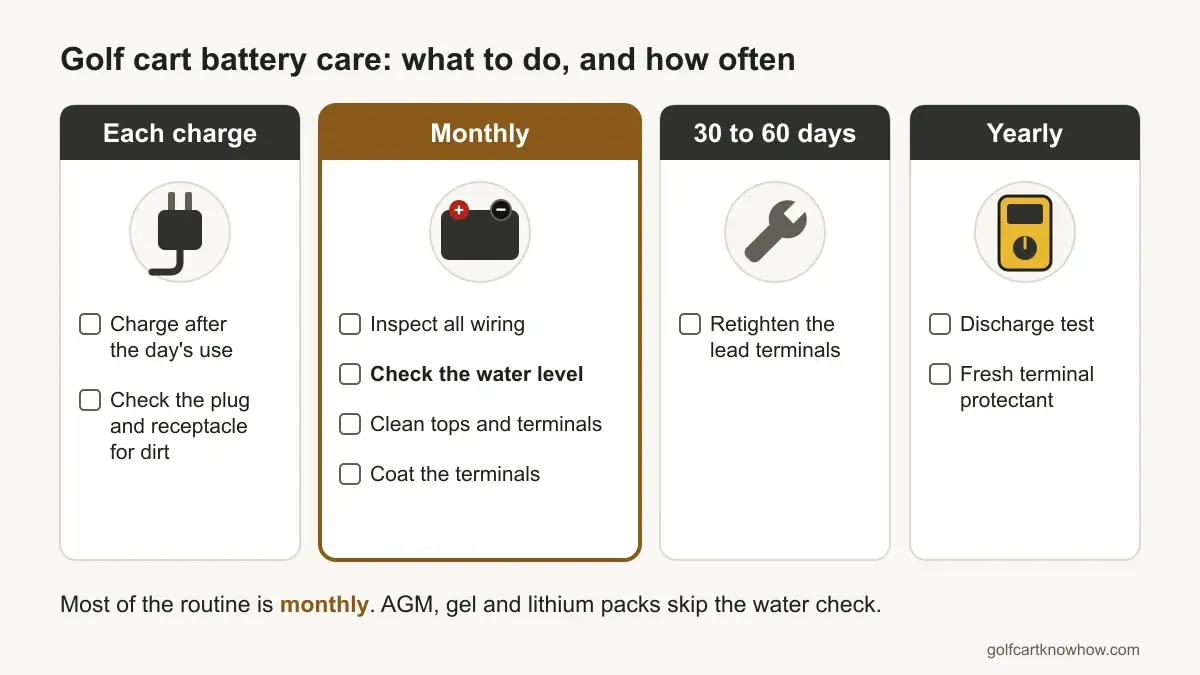
When a dealer says "maintain the batteries," most owners hear a long chore list and do none of it. The makers' actual list is short: charge after you drive, look things over once a month, and have the pack tested once a year. There is no seasonal schedule in any manual.
Golf Cart Battery Maintenance: What to Check Monthly and Once a Year
Some links on this site are affiliate links: if you buy through them we earn a commission, at no extra cost to you. As an Amazon Associate we earn from qualifying purchases.
At a glance
- Monthly: check the wiring, the water, the clean tops and the terminal coating.
- Terminals: torque depends on the terminal type printed on your battery label.
- AGM and lithium: no water, no equalizing, but the same inspection.
On this page (6)
What golf cart batteries need, and how often
Everything the makers ask for fits on one short list. The rest of what people call maintenance is either charging, which happens by itself if you plug in after each use, or the winter program, which is separate.
| Interval | What to do |
|---|---|
| After each use | Charge, and look at the charger plug and cart receptacle for dirt (E-Z-GO TXT and Valor) |
| Monthly | Inspect all wiring for fraying, loose connections, corrosion and damaged insulation; check the water level; clean the tops and connections; coat the terminals |
| Every 30 to 60 days | Retighten the lead terminals (U.S. Battery) |
| Yearly | Discharge test and fresh terminal protectant (Yamaha) |
Club Car asks for a water check every 30 days and more often if you drive more than average; Trojan says monthly until you learn your own pattern. How high to fill and which water belong to watering golf cart batteries. The yearly test is on the battery testing page, and the winter program on storing a cart for winter.
How to clean the batteries and terminals
Do this once a month, or more often in harsh conditions, as E-Z-GO puts it. Never start with a hose: hosing the tops leaves a conductive residue that quietly self-discharges the pack, and it carries acid onto the rest of the cart.
- Check every vent cap is on and tight. Skip the pressure washer entirely.
- Neutralize first. Trojan, U.S. Battery, Club Car and Evolution use 1 cup of baking soda per gallon of water; E-Z-GO sprays 2 teaspoons per quart over the tops, sides and nearby metal and lets it sit three minutes.
- Wipe with a soft brush or cloth. Keep the solution out of the cells: Yamaha warns it causes serious battery damage.
- Rinse with low-pressure clear water and dry.
- Clean the terminals and the inside of the cable clamps to a bright metallic shine. U.S. Battery says a metal bristle brush; Trojan says a post and clamp cleaner.
- Reconnect, then coat: Trojan's anti-corrosive spray or silicon gel, East Penn's petroleum jelly, U.S. Battery's spray applied after the cables are on, or, in damp conditions, a small amount of dielectric grease, as Navitas asks for on its controller connections.
Tip: If you use an aerosol protectant, insulate the can first. E-Z-GO warns that a metal container touching a battery terminal can cause an explosion.
How tight the terminals should be
A loose connection is resistance: it heats up, pulls more amperage and cuts your run time, and U.S. Battery and Trojan both warn it can end in a terminal meltdown or fire. Check them by moving each cable side to side by hand, as Club Car describes. Kandi is specific about doing it by the cable and never by gripping the nut with a tool, and about not driving the cart if one is loose.
| Maker and terminal | Torque (inch-pounds) |
|---|---|
| Trojan ELPT, EUT, LT, UT, WNT | 95 to 105 |
| Trojan AP | 50 to 70 |
| U.S. Battery UT, UTL | 95 to 105 |
| U.S. Battery S, L, flag | 100 to 120 |
| U.S. Battery bus lug | 120 to 180 |
| U.S. Battery SAE | 50 to 70 |
| E-Z-GO TXT 48 post hardware | 90 to 100 (hold-downs 45 to 55) |
| Club Car Onward battery nuts | 110 |
| Yamaha Drive2 wire leads | 80 to 89 (hold-down plates 62 to 80) |
Interstate prints both 100 to 120 and 95 to 105 for a 5/16 inch stud on the same page without reconciling them. Follow the label on your battery, which names the terminal type, and the number in your cart manual. Three rules every maker shares: use an insulated wrench under 6 inches long, because a longer one over-tightens and a mushroomed post never tightens again; never put a washer between the lug and the lead terminal; and recheck controller post torque monthly, as Navitas asks.
Do you need to equalize?
Equalizing is a controlled overcharge of two to four hours after a full charge, for flooded batteries only, never AGM or gel. Five makers give five answers:
- Trojan's maintenance page: only when a cell reads low or the cells spread more than 0.030 after a full charge.
- Trojan's User's Guide: every 30 days.
- U.S. Battery: at least monthly, every two weeks if cycled daily.
- East Penn: only below 1.250 or at a 0.030 spread, measured hourly until the reading stops rising.
- Interstate: every 4 to 6 weeks, or at a 0.010 to 0.015 spread, for two hours.
Follow whoever made your batteries. They agree on two things: check the water first, because equalizing gasses hard, and your charger must have an equalize setting. The specific gravity reading comes from a hydrometer, covered on the testing page.
Tip: Trojan's own web page and its User's Guide disagree, one saying only when readings call for it and the other every 30 days. Go by the document that shipped with your batteries.
AGM and lithium packs
AGM and gel never get water (Trojan), are never equalized (Trojan and East Penn) and never have their caps removed. They still get the monthly inspection, clean dry tops and tight terminals.
Lithium packs need no water and no baking soda. Power the pack off, wipe the top, sides and terminals with a damp cloth or non-metallic brush, check the mounting brackets are still secure, and never pressure wash or spray the pack. Terminal torque is the pack maker's own figure, not the lead-acid numbers: Trojan's 2026 OnePack User's Guide prints 88.5 to 106.0 inch-pounds for its M8 terminals, while the 2025 48V Series guide printed 50 to 60, so check which guide came with your pack. E-Z-GO and Evolution assign any pack or cable work on a lithium cart to an authorized service facility, and Kandi adds that the pack should be parked somewhere cool, dry, shaded and ventilated. The running-cost difference is covered in lithium versus lead-acid.
Common questions
How often should I check golf cart batteries if I only drive on weekends?
Keep the monthly schedule. E-Z-GO, Yamaha and Club Car all print the interval as every month or every 30 days, with no hours-driven alternative. Club Car's only adjustment runs the other way: check the water more often if you drive more than average.
Do I need a torque wrench for golf cart battery terminals?
An inch-pound torque wrench with insulated tape is the only way to hit figures like 95 to 105 inch-pounds. If you tighten by feel, use a wrench under 6 inches long, since U.S. Battery warns a longer one over-tightens and damages the terminal.
What does it mean if a battery top is wet after charging?
Fluid on or around a flooded battery can mean electrolyte is spilling, leaching or leaking, and Trojan says a leaking battery must be repaired or replaced. Clean and dry the top, then watch whether it comes back after the next charge.