You have a cable set in your basket and no idea whether to click 4 gauge or 6 gauge. No cart maker prints the gauge or length of its battery cables, so the listing for your cart is the answer, and sets come in both. Heavier copper matters after a controller or motor upgrade; on a stock cart, a loose or crusty connection does more damage than thin wire.
Golf Cart Battery Cables: Gauge, Length, Corrosion and Replacing Them
Some links on this site are affiliate links: if you buy through them we earn a commission, at no extra cost to you. As an Amazon Associate we earn from qualifying purchases.
At a glance
- Gauge: Both 4 gauge and 6 gauge sets are sold for the same E-Z-GO TXT, so pick by the listing, not the cart model.
- Melted terminal: A loose nut is the most common cause, not undersized cable.
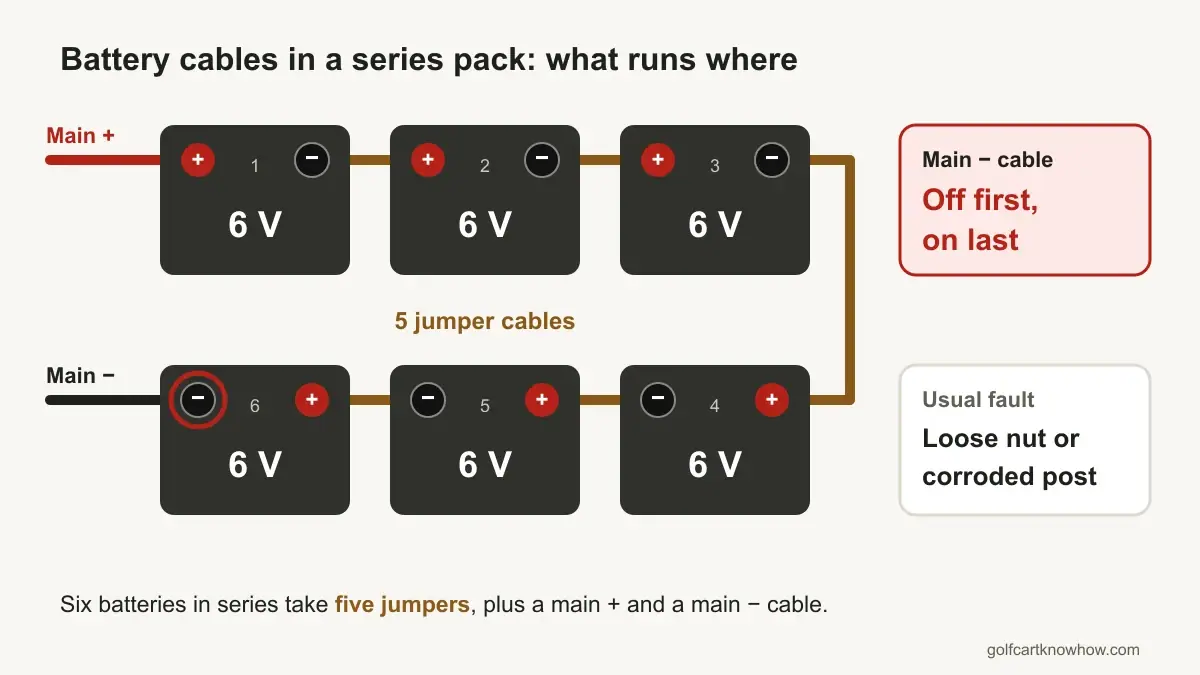
- Order: Main negative cable off first, back on last.
On this page (6)
Our picks
- Club Car Precedent, 2008 on, 48 V: 10L0L 4 gauge cable set
- E-Z-GO TXT or Medalist, 1994 on: DRIVE UP 4 gauge cable set
- Keeping the posts clean: Steelman post and terminal brush and CRC terminal protector spray
What gauge are golf cart battery cables?
AWG is just a size number: the smaller it gets, the fatter the copper. The battery makers publish how much current each size carries, which is the only hard figure in this whole question. Trojan and U.S. Battery both print the same table, taken from the electrical code for copper cable at 167°F (75°C).
| Cable size (AWG) | Maximum amps |
|---|---|
| 8 | 50 |
| 6 | 65 |
| 4 | 85 |
| 2 | 115 |
| 1 | 130 |
| 1/0 | 150 |
| 2/0 | 175 |
| 4/0 | 230 |
What the table cannot tell you is what your cart needs, because no maker publishes what the motor actually draws. Go heavier when you have changed the drivetrain: Alltrax sets 6 AWG as the minimum for a 200 or 300 A controller in standard duty and 4 AWG for heavy duty, with short power runs and properly crimped terminals, and Navitas says that if the cables or motor get too hot to touch, go to at least 4 AWG, with 2 AWG preferred and a 200 A or larger solenoid. MadJax sells its 4 gauge welding-cable set for the 1988 to 1994.5 Marathon as a performance upgrade for high-torque motors, not as the factory size.
Tip: Buggies Unlimited lists both a 4 gauge and a 6 gauge set for the same 1994.5-on TXT in its 6 V layout. That is the clearest sign gauge is a choice the cable makers offer, not a number E-Z-GO fixed.
How long should the cables be?
You do not measure these yourself. Sets are sold per cart and pack layout with fixed lengths, and the count follows the layout: the 2008.5-on Precedent 8 V set is one 9.5 inch, two 12 inch and two 23.5 inch cable, five cables to join six batteries in series. Trojan's rule is simply that cables be long and flexible enough not to pull on the terminals.
Two length rules from the battery makers do matter if you are making your own or running an accessory: a run over 6 feet may need a heavier gauge to keep the voltage drop acceptable, and inside a pack every series cable should be one length and every parallel cable another single length. How many cables your layout takes is set by how the pack adds up to 36 V or 48 V, and the per-brand routing lives with the official wiring diagrams.
On an E-Z-GO TXT 48, every electrical accessory grounds directly to the battery negative post, never to the chassis or body, and anything not on the accessory harness must draw from the whole 48 V pack.
How to tell a cable or connection has gone bad
Walk the pack with the key off and look for these, in the makers' own terms:
- A cable or the motor too hot to touch after a run (Navitas).
- A melted terminal. U.S. Battery lists the causes in order: loose connections first, then over-tightening, a cable too small, corroded connections, a washer in the wrong place, too many cables on one post, or discharging harder than the battery is rated for.
- Poor performance, terminal damage, meltdown or fire from a faulty connection (Trojan).
- Shorter run time, because loose connections add resistance and pull more amperage (Club Car).
- Broken or frayed insulation. Trojan calls those extremely hazardous and says to replace any cable that looks suspicious.
Check tightness by moving each cable a few inches side to side by hand, not by gripping the nut with a wrench, and do not drive the cart with a loose terminal. The exact torque depends on your battery's terminal type; the figures by maker sit on the monthly maintenance page.
Why the terminals keep corroding
Corrosion builds on terminals that are not kept clean and dry, and the film is not cosmetic: dirt, acid or water sitting on the battery tops lets current track across them, which leaks charge and can short the pack. Cleaning is a routine job, covered step by step on the maintenance page above.
Two things belong to the cables specifically. First, protection goes on after the cables are tightened, never before: U.S. Battery says to install the cable and hardware and then spray both. Trojan's terminal protector spray, East Penn's petroleum jelly, or dielectric grease on the connections in damp conditions all work. Second, corrosion in the battery rack itself needs a putty knife and wire brush, a baking soda and water wash, thorough drying, then corrosion-resistant paint.
Tip: E-Z-GO warns to insulate an aerosol can of terminal protectant before spraying. If the metal can touches two terminals, it can cause an explosion.
Replacing the cables, and which one comes off first
- Key OFF and removed, jewelry off, insulated tools only. On an E-Z-GO TXT, move the Run-Tow/Maintenance/Storage switch to TOW/MAINTENANCE/STORAGE before touching any wiring.
- Mark or photograph polarity before anything comes off (East Penn).
- Take the negative side off first. E-Z-GO's Valor manual says main negative (BL-), then main positive (BL+); Yamaha says the negative cable to the motor controller comes off first and goes back on last; East Penn says ground cable first off, positive first on.
- Keep loose cables from touching any terminal or each other, and off the vent caps. Kandi's warning is the one to respect: a short across a pack can reach thousands of amperes, with enough heat to split a battery. If you are not confident the pack is isolated, let a technician do it.
- Fit the new cables with clean, corrosion-free ends, the lug directly against the terminal with no washer between them, torqued to your battery's terminal spec.
- Check the polarity of every battery before the last cable goes on, and use specified replacement parts (E-Z-GO ties lesser parts to the warranty).
East Penn's rule is to replace frayed cables or bad ends whenever you install batteries. On lithium packs, do not: E-Z-GO ELiTE and Evolution both say the pack cables are authorized-service work only.
Common questions
Do I need new cables when I change the batteries?
Not automatically, but East Penn says to replace frayed cables or bad cable ends whenever batteries are installed. Since the pack is already apart, inspect every lug and every inch of insulation then, and swap the set if anything looks suspicious.
Can I use welding cable for golf cart batteries?
Yes, and it is sold that way: MadJax's 4 gauge set for the 1988 to 1994.5 E-Z-GO Marathon is welding cable, offered as a performance upgrade for high-torque motors. Welding cable is finely stranded, so it stays flexible in short pack runs.
Does a thicker battery cable make the cart faster?
Not on a stock cart. Heavier cable earns its keep once a controller or motor pulls more current than the original wiring was sized for, which is why Alltrax and Navitas call for 6, 4 or 2 AWG with their upgrades.