When a cart quits, it is tempting to blame the motor or the controller. Start where the makers' own troubleshooting tables start: the battery pack, then the charger, then the solenoid, then the controller. Checking the pack voltage first costs nothing.
Golf Cart Maintenance and Repair: The Schedule, the Parts That Fail, and Where to Start When It Stops

On this page (4)
Which symptom do you have?
Find your symptom below and follow it through to the page that works it in order. Each one starts with the checks you can do yourself with a multimeter and a wrench.
- It will not move at all: key on, nothing happens, or you hear a click and the cart sits there. Work through the first checks for an electric cart that will not move.
- It will not charge: the charger does not come on, cuts out early, or the pack never comes back up. That is a charger that is not working.
- It runs slow or jerky: it crawls up hills, stutters, or loses power when warm. If it starts strong and then levels out slow, check the speed sensor once the pack checks out.
- Gas cart will not start: cranks but will not fire, or does nothing at all. See what to check on a gas cart that will not start.
- It will not stop properly: a soft pedal or a parking brake that will not hold belongs with golf cart brakes.
Tip: The makers' troubleshooting tables are ordered by likelihood, and the tables open with the batteries and the connections, not the drive system. Owners who skip that first step are the ones who buy a controller they did not need.
Which part is it, and can I replace it?
Four parts come up on an electric cart, each with its own guide.
The solenoid is the switch that sends pack power to the motor. A loud click with no movement, or no click at all, usually points here. The guide walks through the makers' own test for it.
Power to the motor is metered by the controller. Its symptoms (no power, cutting out, error codes) overlap with weak batteries and bad cables, so rule those out first.
The motors guide covers the motor types and what a replacement has to match.
Chargers are the easiest of the four to rule out: borrow a known-good one, or take yours to a dealer. The charger guide covers what a replacement has to match.
Tip: Before you buy any part, get the wiring diagram for your exact model year. Brands wire their packs and their safety circuits differently, so the part number and the test points are not interchangeable between carts that look alike.
Looking after the cart
On an electric cart, the routine that matters is battery maintenance: water levels, clean terminals, tight connections and a full charge after use. A reverse buzzer that has gone quiet is worth fixing on a street-driven cart. Gas owners have their own short list, centered on the engine: oil, filters, belt and plug.
Where to stop and call a technician
Plenty of this is owner work. Some of it is not, and the makers say so in their own service literature.
- Live pack cabling and series connections. A golf cart pack holds enough current to arc hard across a dropped tool. Disconnecting and rewiring a pack is a technician's job.
- Controller and motor replacement. Leave both to a dealer or a golf cart technician.
- Brakes. Adjustment is often documented for owners; shoes, cables and the parking brake mechanism are not jobs to guess at.
- Anything that raises top speed. Changing a cart's governed speed can push it past what its brakes, tires and street-use status were built around, and past the federal rules for low-speed vehicles.
- Lithium conversions. These change the charging system and the battery management, not just the boxes under the seat.
If a repair needs the pack disconnected, needs programming, or affects how the cart stops, that is the line.
All guides in this section
-
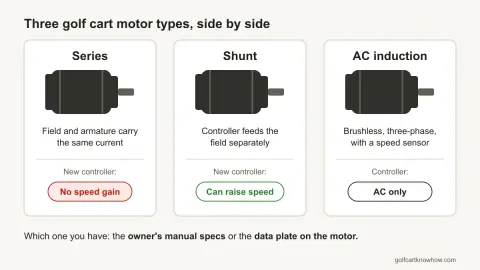 Electric Golf Cart Motors: Series, Shunt and AC, and When the Motor Is the Fault
Series, shunt and AC golf cart motors by maker and era, how each behaves, the makers' signs that the motor is the fault, and when an upgrade makes sense.
-
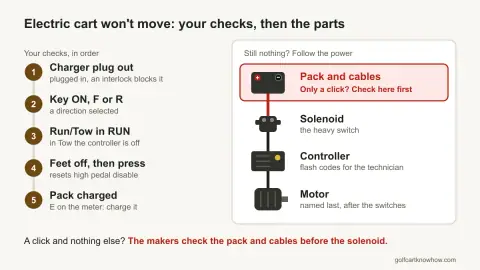 Electric Golf Cart Will Not Move: What to Check First
An electric golf cart that will not move: the plug, switch and pedal checks first, what a click or silence points to, and where the makers stop you.
-
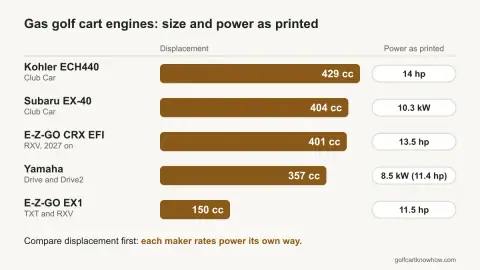 Gas Golf Cart Engines: Kohler, Subaru, Yamaha and the E-Z-GO EX1
Which engine is in a gas Club Car, E-Z-GO or Yamaha golf cart, the makers' own specs and service intervals, and what the makers say about replacing one.
-
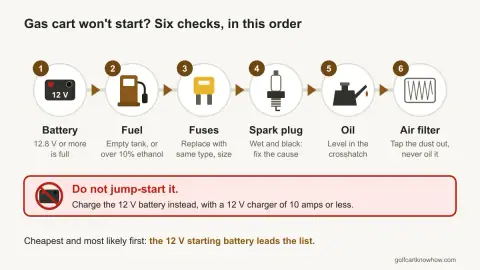 Gas Golf Cart Will Not Start: What to Check First
A gas golf cart that will not start: start sequence, then battery, fuel, fuse and spark plug checks in order, the fault light, and when it is a dealer job.
-
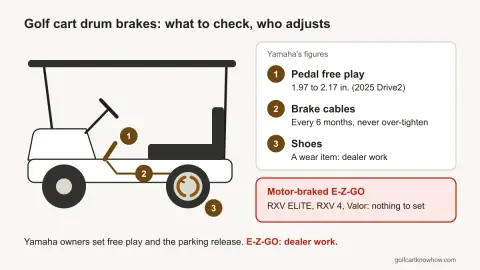 Golf Cart Brakes: Checking, Adjusting and the Parking Brake
Checking and adjusting golf cart drum brakes, the parking brake, which carts brake with the motor instead, and where the makers send the work to a dealer.
-
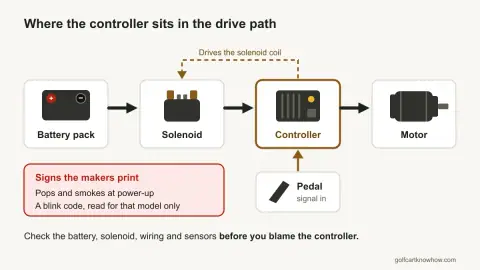 Golf Cart Controllers: What They Do, Failure Signs, and Stock vs Navitas and Alltrax
What a golf cart controller does, which one your cart has, the fault signs the makers print, who should replace it, and what Navitas and Alltrax offer.
-
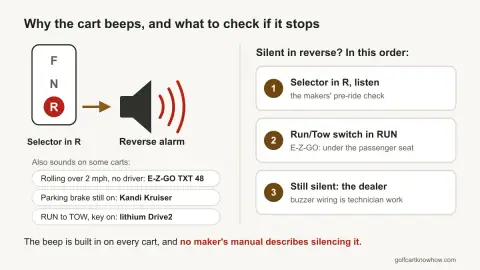 Golf Cart Reverse Buzzer: Why It Sounds and What to Do When It Stops
Why a golf cart beeps in reverse or in forward, by maker, how to check the alarm, what to do when it stops, and what the makers say about turning it off.
-
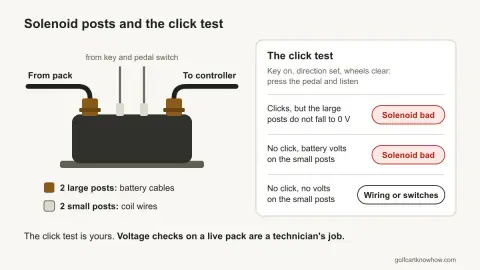 Golf Cart Solenoid: Signs It Has Failed, the Makers' Tests, and Choosing a Replacement
What the solenoid does on an electric golf cart, the signs the makers tie to a bad one, the click check you can do, and what a replacement must match.
-
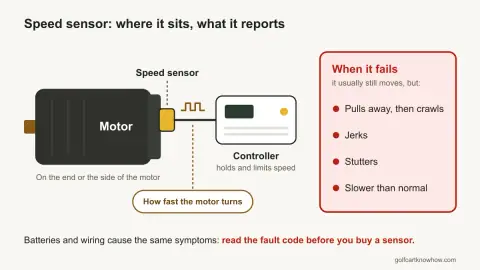 Golf Cart Speed Sensor: Symptoms, How It Is Tested, and Who Replaces It
What the motor speed sensor does on an electric golf cart, which carts have one, the symptoms the makers print, and how it is tested and replaced.
-
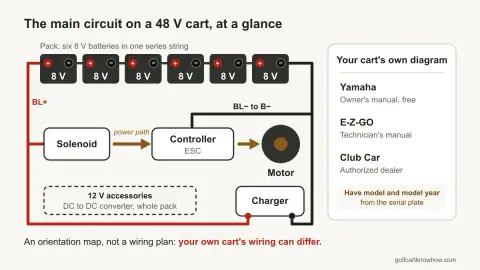 Golf Cart Wiring Diagrams: Where to Get the Official One and How Each Brand Wires Its Pack
Who publishes the wiring diagram for E-Z-GO, Club Car and Yamaha carts, how each maker lays out the 36 V or 48 V pack, and what free online diagrams show.