You lift the seat, see six batteries and a jug of water, and nobody has told you how often or how much. Flooded lead-acid batteries lose water every time they charge, so they need topping up on a schedule you learn by watching your own cart. Sealed AGM, gel and lithium batteries are never opened.
Watering Golf Cart Batteries: How Often, How Full and Which Water
Some links on this site are affiliate links: if you buy through them we earn a commission, at no extra cost to you. As an Amazon Associate we earn from qualifying purchases.
At a glance
- How often: Check monthly, and every few weeks while the batteries are new.
- When: Add water after a full charge, never before it.
- How much: Never below the plates, never up to the cap.
On this page (6)
Our picks
- Filling by hand: Mighty Max 2 quart filler with auto shut-off
- 48 V pack of six 8 V batteries: Flow-Rite Pro-Fill watering kit
- 48 V Club Car, six 8 V batteries: Trojan HydroLink watering kit
Do my batteries need water, and how often?
If your batteries have caps you can remove, they are flooded, and they need water. Water is lost through gassing on every charge, which Trojan calls completely normal. Water is never added to AES, AGM or gel batteries, and a lithium pack is sealed for life.
The makers set the interval differently, so start with the strictest one that applies to you:
- Trojan: monthly until you learn your own rate, and every few weeks on new batteries.
- U.S. Battery: every few weeks on new batteries.
- Crown: every two weeks when new, then weekly as they age.
- Club Car: every 30 days, more often if you drive more than normal.
- E-Z-GO: monthly, and every 30 days while the cart is stored.
- Yamaha: monthly.
Expect to add water more often as the pack ages, in heat, and with heavy use. Every maker says so in its own words.
Before or after charging?
After. Trojan, U.S. Battery, Crown and Club Car all put watering at the end of a full charge, because the electrolyte level rises as the pack charges and water added early simply overflows. A brand-new battery gets charged first for the same reason.
The one exception is a cell with the plates showing. Then add just enough water to cover the plates, charge the pack, and top up to the proper level afterward. Never charge a battery whose plates are exposed.
Tip: Two jobs clash with watering. Do not add water right before a hydrometer reading, because it lowers the specific gravity. And check levels before an equalizing charge, which gasses hard and uses water.
How full should the cells be?
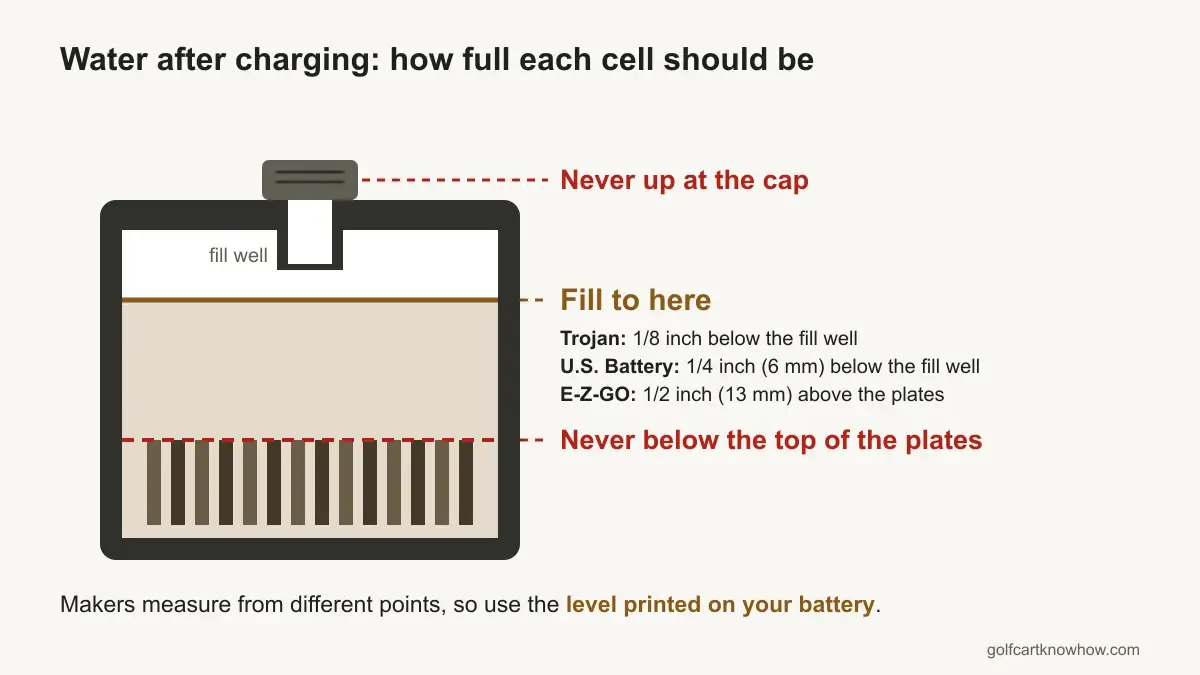
The minimum is always the top of the plates and the maximum is never the cap. Between those, the makers measure from different places, so the figure that counts is the one printed for your battery.
| Battery maker | Level it prints |
|---|---|
| Trojan | 1/8 inch below the bottom of the fill well (Plus Series: to the maximum level indicator) |
| U.S. Battery | 1/4 inch (6 mm) below the bottom edge of the fill well tube |
| E-Z-GO (TXT 48, Valor) | 1/2 inch (13 mm) above the plates, leaving 1/4 to 3/8 inch below the vent tube |
| Crown | Above the plates, no higher than the vent well |
Club Car prints no height at all, only "do not overfill". Follow the label on your battery or your cart manual, and a piece of rubber makes a safe dipstick for judging the level.
Both mistakes cost money. Plates left exposed to air corrode and are ruined beyond repair. Overfilling dilutes the electrolyte and pushes acid out of the vent, where the water evaporates and the sulphuric acid stays on your cart and your garage floor. Trojan's warranty excludes both under- and over-watering.
Tip: The three fill rules are not a contradiction. Trojan and U.S. Battery measure down from the fill well; E-Z-GO measures up from the plates. That is why the level on the battery's own label beats any rule of thumb you read.
Which water, and is tap water ever acceptable?
Distilled is the water every maker names first. The alternatives differ:
- Trojan: distilled or deionized, distilled preferred because deionized can still carry minerals. Never water with a high mineral content.
- Crown: distilled or demineralized.
- Club Car: distilled, with filtered water from some dealers as the alternative it names.
- E-Z-GO: distilled, or water purified by filtration that meets the purity table in its guide. Water that is not distilled is to be analysed first, even if it looks and tastes fit to drink.
- Yamaha: distilled or purified, not tap water.
U.S. Battery's manual disagrees with itself. Its safety list says distilled or deionized only, or the warranty is void; its watering section says tap water may be used within impurity limits it never prints. Treat that as a reason to buy a jug of distilled, not as permission. Never add acid or anything else to a cell.
Doing it safely, step by step
- Charge the pack fully.
- Put on goggles or a face shield and gloves.
- Remove the vent caps and set them upside down, so the dirt on the underside stays out of the cells. Trojan Plus Series caps flip open instead.
- Look into each fill well and compare the level against your maker's figure.
- Add water cell by cell with a hand-held watering device or a measuring jug.
- Refit and tighten every cap.
Hydrogen is explosive at a 4 percent concentration, so water and charge in a ventilated space and do not smoke near the pack. Caps stay on while charging: U.S. Battery calls removing them for charging an explosion hazard. Neutralize any spill with 1/4 cup of baking soda in 1 1/2 gallons of water.
A single-point watering system fills every cell to the set level from one connection. Trojan's HydroLink fills a set in under 30 seconds and will not fit Plus Series batteries; Crown and U.S. Battery name Flow-Rite, and U.S. Battery also names BWT. For a 48 V pack of six 8 V batteries, Flow-Rite sells the Pro-Fill 48 V kit, and Trojan sells a HydroLink kit for the 48 V Club Car. E-Z-GO sells a battery maintenance kit with an automatic filler. A hand-held filler with an automatic shut-off, like the Mighty Max 2 quart filler, does the same job, more slowly. If levels keep dropping fast, test the pack before spending on a system.
Common questions
How much water does a golf cart battery take?
No maker prints a quantity in ounces or gallons, because it depends on how much the cell has lost. You fill to a level, not to a measure: up to your battery maker's mark, and never to the cap.
Does needing water more often mean my batteries are wearing out?
More frequent watering is normal as flooded batteries age, and Trojan, U.S. Battery and Crown all say so. It is not a fault on its own, but it is a reason to watch how much life is left in the pack.
Do brand-new golf cart batteries need water before the first charge?
No. A new battery may look low, but Trojan says to charge it first and add water only afterward if needed. Water added before that first charge pushes electrolyte out of the vents.