Your cart gets halfway around the neighborhood and then sags on the first hill. Most owners replace the whole set at that point, when often one battery is dragging the others down with it. A meter on each battery finds the weak one, a hydrometer shows which cell has gone, and only a shop's discharge test measures what capacity is left.
How to Test Golf Cart Batteries: Multimeter, Hydrometer and the Load Test
Some links on this site are affiliate links: if you buy through them we earn a commission, at no extra cost to you. As an Amazon Associate we earn from qualifying purchases.
At a glance
- Finding the bad one: after a long rest, read every battery and look for the one sitting more than 0.3 V below the rest.
- Rest first: a reading taken straight off the charger flatters every battery in the pack.
- What a meter cannot do: only a discharge test at a battery shop shows how much capacity is left.
On this page (7)
Before you put a meter on anything
A reading taken on a half charged, dirty or loose pack tells you nothing useful, and Trojan says plainly that looking the batteries over is not enough by itself.
- Safety glasses and gloves on, watch, rings and chains off. Lead-acid batteries give off hydrogen, and a spark across the posts is what sets it off.
- Use an insulated wrench no longer than 6 inches. U.S. Battery warns that bigger wrenches over-tighten and damage terminals; E-Z-GO says to wrap the handle in vinyl tape.
- Key off and out of the switch. On an E-Z-GO TXT, move the Run-Tow switch to Tow before any cable is touched.
- Charge the pack fully. A partly charged pack reads low on every maker's table and makes a healthy battery look finished.
- Clean the tops and terminals, then tighten any loose connection.
- Check that the plates are covered. If they are not, top the cells up and run one charge and discharge cycle before any hydrometer reading: fresh water sits on top of the electrolyte and reads low.
- Never put a metal thermometer into a cell.
Reading each battery with a multimeter
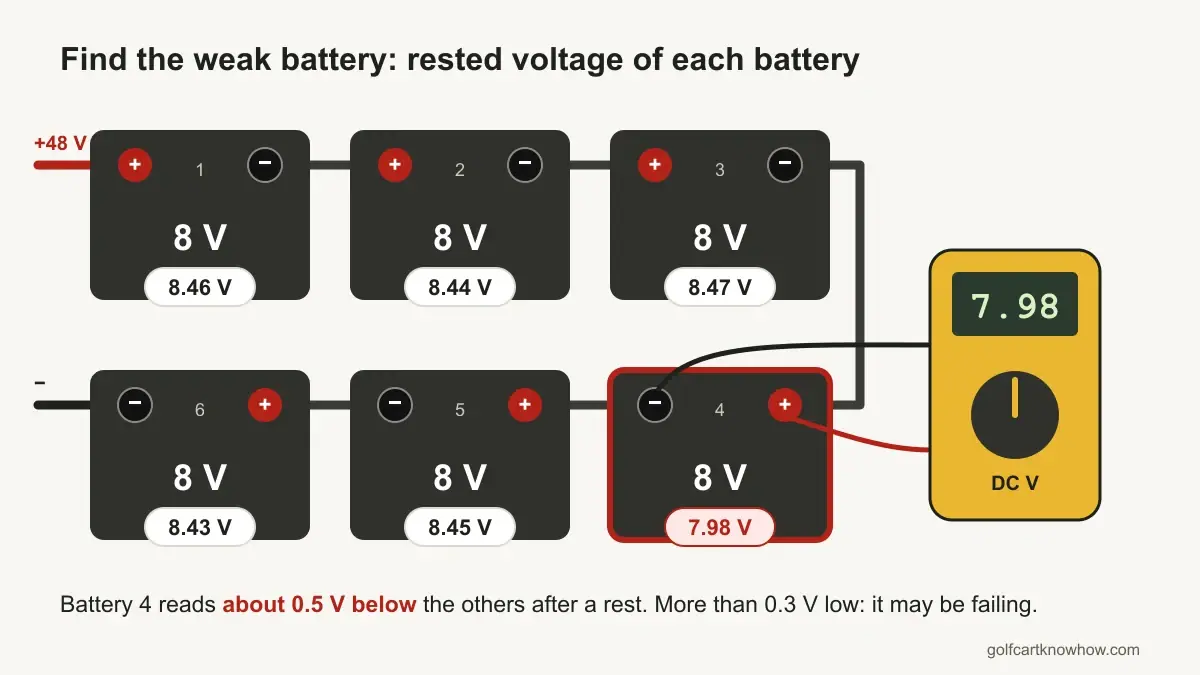
Leave the pack standing overnight with nothing charging and nothing drawing, and you satisfy every maker's rest time. Then set a digital multimeter, such as the AstroAI 6000-count meter, to DC volts, touch the probes to the two posts of one battery, write the number down, work along the row and compare.
Worth knowing: the makers do not agree on rest time. Interstate asks 30 to 60 minutes, U.S. Battery 4 to 6 hours for flooded and 24 for AGM, Crown at least 8 hours after a charge, Trojan at least 6 and preferably 24.
What matters is the spread, not one perfect number. Trojan, U.S. Battery and Crown all treat a battery more than 0.3 V away from the others as a possible failure, while East Penn draws the line at 0.05 V. Trojan asks you to equalize the set once and read again before calling a battery dead. Your own battery voltage is printed on the label on top of each case.
| Battery | Trojan and U.S. Battery, full | Crown, full | Interstate table | Half charged |
|---|---|---|---|---|
| 6 V | 6.37 V | 6.30 V or more | 6.42 V | 6.05 V |
| 8 V | 8.49 V | 8.40 V or more | 8.64 V | 8.07 V |
| 12 V | 12.73 V | 12.60 V or more | 12.84 V | 12.10 V |
Interstate's own FAQ is gentler than its table, calling about 8.6 V and 12.7 V healthy. U.S. Battery calls the rested voltage reading its least preferred test because open-circuit voltages mislead, so treat it as a screening step rather than a verdict.
Finding the weak cell with a hydrometer
On flooded batteries the hydrometer looks inside each cell, which is how you tell a flat battery from a failed one.
- Use a hydrometer with a built-in thermometer made for batteries.
- Fill and drain it two to four times before the first sample.
- Read every cell and return the electrolyte to the cell it came from.
- Correct to 80°F (27°C): add 0.004 for every 10°F above, subtract 0.004 for every 10°F below. E-Z-GO's example is 1.250 at 90°F, which is really 1.254, and 1.246 at 70°F. Electrolyte stays warmer than the air after a drive, which is why the thermometer matters.
| Maker | Full charge | Spread that means trouble | What they say to do |
|---|---|---|---|
| Trojan | 1.277 | More than 0.030 between cells | Equalize the set, then suspect a failed battery |
| U.S. Battery | 1.270 minimum | 0.015 between cells | Equalize; one cell 0.050 off is a bad cell |
| E-Z-GO | 1.275 to 1.280 new | Fifty points between cells | Recharge and repeat before blaming the battery |
| Crown | At least 1.225 in every cell | More than fifty points | Replace the battery |
| Yamaha | 1.260 at 80°F | More than one point between cells | See a dealer |
East Penn uses the same fifty points as its sign of a failing cell. One thing needs no table: brown or gray electrolyte means that battery is near the end of its life.
Worth knowing: a full-charge reading that has drifted down over the years is ordinary aging. E-Z-GO says that on its own is not a reason to replace the battery, as long as every cell sits within fifty points of the others.
The two tests past the meter
The first one you can do yourself. In the last half hour of a charge, when the charger has dropped under 5 A and a 48 V pack reads above 56 V, read each battery while it is still on charge. An 8 V battery below 9.3 V, or 0.7 V under its neighbors, may have failed. The 6 V limits are 7 V and 0.5 V, the 12 V limits 14 V and 1.0 V, and Trojan and U.S. Battery print the same figures.
The second is a shop job. A discharge machine is the only way to measure capacity: the pack is run down at 75 A until a cell drops to 1.75 V, the minutes are timed against the battery's rated minutes, and East Penn says 50 percent or less of the rating means replace. Yamaha puts a discharge test on the yearly list. Any battery shop or cart dealer with the machine can run it.
The hand-held tester at the parts counter is a different animal. Trojan and U.S. Battery both say internal-resistance (CCA) and carbon-pile testers are not suitable for deep cycle batteries. Crown does use a carbon-pile tester at 50 to 75 A for 15 seconds, but to screen for an internal fault, not to measure what is left.
What the numbers mean for your wallet
A battery that charges up fine and then collapses the moment you drive is most likely bad, in Trojan's words. Bringing one back is a short list: full charge, one equalize, read again. A weak cell found with the hydrometer cannot be restored, and U.S. Battery's replacement point is 50 percent of rated capacity.
Two batteries test low without being bad. A new one is still maturing, which takes 50 to 100 cycles on Trojan's figures and up to 100 on E-Z-GO's. A cold one simply has less to give: Trojan puts a battery at half its rated capacity at 0°F and all of it at 80°F.
Replace one or all? E-Z-GO says swap the weak battery for one of the same brand, type and approximate age. Trojan does not recommend partial replacement of a flooded bank at all, because old and new batteries take charge differently and the new one gets overcharged. The age of the rest of the set decides it: an early failure in a young set is worth a matched replacement, while a set with years on it goes out together. The cost of that decision is on the lifespan page.
AGM, gel and lithium packs
Never open the caps on an AGM battery, so there is no hydrometer step here. Use the meter against the AGM figures instead: U.S. Battery puts a full 12 V AGM at 13.00 V, an 8 V at 8.67 V and a 6 V at 6.50 V, while East Penn prints 12.8 V for a full 12 V gel or AGM at 77°F. Give AGM a full day of rest before reading.
A lithium pack reports its own state of charge through the cart's gauge or app, so there is nothing for a meter or hydrometer to do. E-Z-GO tells ELiTE owners not to remove the pack or its cables and assigns all pack and electrical service to an authorized facility. That is the stop line on a lithium cart, whatever the symptom. How the two chemistries compare over a decade is on the lithium and lead-acid page.
Common questions
What should a full 48 V golf cart pack read on a multimeter?
On Trojan's and U.S. Battery's figures, a rested, fully charged 48 V flooded pack reads 50.93 V overall. That is six 8 V batteries at 8.49 V each, or four 12 V batteries at 12.73 V each. Read the pack and then each battery.
Do I need a special golf cart battery tester?
No. A digital multimeter set to DC volts and a battery hydrometer cover everything an owner can usefully do on a flooded pack. The machine that measures real capacity is a discharge tester, and that lives at a battery shop.
How often should golf cart batteries be tested?
Evolution puts a hydrometer check on its monthly maintenance list for lead-acid packs, and Yamaha lists a discharge test once a year. A quick rested voltage reading each month costs nothing and catches a battery drifting away from the set early.