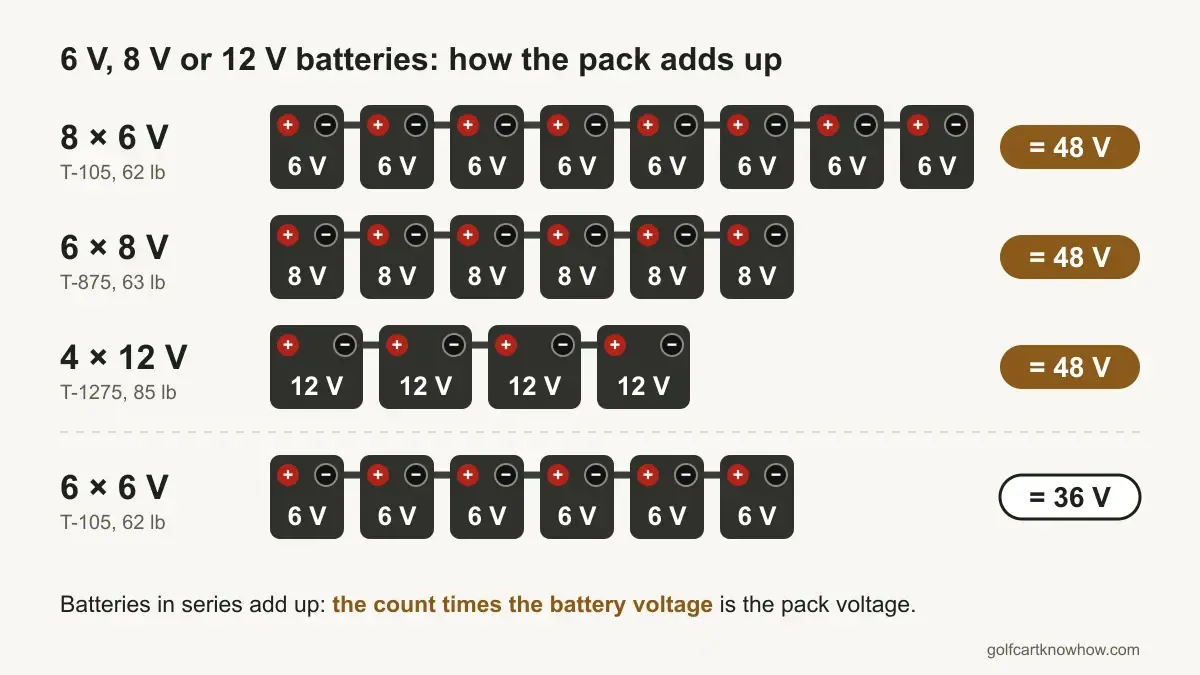
Lift the seat and you see six batteries, or maybe eight, or four. The number does not tell you much on its own, and buying the wrong set is an expensive mistake. Your cart's voltage is simply the batteries added together, and 6 V, 8 V and 12 V are three ways of reaching the same total.
6 V, 8 V and 12 V Golf Cart Batteries: How They Add Up to a 36 V or 48 V Pack
At a glance
- The math: Battery voltage times the number of batteries gives the cart voltage.
- Three ways to 48 V: Eight 6 V, six 8 V or four 12 V batteries.
- Replace like for like: The tray and group size change with the battery voltage.
On this page (6)
What is the difference between a 6 V, 8 V and 12 V battery?
They differ in how many cells are stacked inside one case, which sets the voltage, the case size and the weight. Here is what Trojan publishes for its three golf car models in its data sheets and 2026 specification guide, with the pack weights multiplied out.
| Battery | Cells | BCI group | In a 48 V pack | Pack weight (calculated) |
|---|---|---|---|---|
| 6 V | 3 | GC2 | Eight | 496 lb |
| 8 V | 4 | GC8 | Six | 378 lb |
| 12 V | 6 | GC12 | Four | 340 lb |
A higher battery voltage means fewer, heavier blocks sitting in a differently shaped tray, which is why the three are not swapped one for one. Capacity and the rest of the figures per model are on the Trojan battery page.
How the batteries add up to 36 V or 48 V
Wiring batteries in series adds their voltages and leaves capacity where it was; wiring in parallel adds capacity and leaves voltage where it was. Trojan's own example: two 6 V batteries rated 225 Ah in series give 12 V and 225 Ah. A golf cart pack is one long series string, so the same arithmetic runs all the way to 36 or 48 V. Both Trojan and U.S. Battery cap parallel wiring at three strings.
For 48 V, Trojan names all three builds: eight 6 V, six 8 V or four 12 V, with compartment size, the performance you need and cost deciding which one a cart can take. For 36 V, the layout you will hear is six 6 V batteries. No cart maker's manual read for this page states it; it comes from RoyPow's conversion guide and Crown Battery's general line that carts run 6, 8 or 12 V batteries in 36 or 48 V sets. Crown also makes the point that matters most: a series set is only as strong as its weakest battery. Which post connects to which is on the wiring diagram page.
Tip: Yamaha sells the 2027 Drive2 PTV PowerTech AC with six 8 V batteries as standard and eight 6 V as an option, on the same 48 V cart. The count is a choice of capacity and tray, not a rule of the voltage.
Which layout does your cart have?
Lift the seat, count the batteries, read the voltage printed on one label and multiply. The charger label is your second check, since it is rated for the pack it was sold with. For scale: an E-Z-GO TXT 48 from 2014 on runs six 8 V; the AC-drive Valor from 2024 on runs four 12 V; Club Car lists six 8 V for the Onward and Tempo, and U.S. Battery lists four 12 V for what it calls the Precedent Champion, a name Club Car itself does not use. Those are examples, not a pattern by year. Your own model is covered on the fit pages: which batteries fit a Club Car and which batteries fit an E-Z-GO.
Can you switch to a different battery voltage?
Putting four 12 V batteries where six 8 V used to sit is not a like-for-like swap: the count, the tray and the group size all change, from GC8 to the longer GC12. Trojan says the compartment's length, width and height, your performance needs and cost limit which 48 V build a cart can take, and every battery needs at least 0.5 inch (12.7 mm) around it for expansion and airflow. Yamaha's answer on fitting batteries other than the ones it recommends is simply No.
Same-size swaps live inside one voltage: Trojan's T-605, T-105 and T-125 share one case and differ only in capacity. And replace the whole set, never one battery. Old and new blocks in one string take charge differently, so the charger quits early for the tired ones or cooks the new ones, and a failing battery drags down the rest.
Tip: Lithium packs change the voltage picture again and need their own charging setup. That comparison, including cost over time, sits on the lithium vs lead-acid page.
What a healthy battery and pack should read
Charge fully, switch everything off and let the pack rest, then put a multimeter across one battery and across the whole pack. Trojan's full-charge open-circuit figures for flooded batteries, measured after at least 6 hours of rest and preferably 24:
| What you measure | Full charge |
|---|---|
| 6 V battery | 6.37 V |
| 8 V battery | 8.49 V |
| 12 V battery | 12.73 V |
| 36 V pack | 38.20 V |
| 48 V pack | 50.93 V |
Interstate Batteries uses a shorter rest of 30 to 60 minutes and prints about 8.6 V for an 8 V battery and 12.7 V for a 12 V one, so a reading slightly above Trojan's after an hour is normal. The on-charge check, the load test and specific gravity are covered in how to test golf cart batteries.
Common questions
Does the number of batteries change how far the cart goes on a charge?
Not by itself. In a series string, adding batteries raises voltage, not capacity, so an eight 6 V and a six 8 V pack are both 48 V. Range comes from the capacity each battery is rated for, which varies by model.
Why is one weak battery a problem for the whole pack?
Because every battery in a series string carries the same current. Crown Battery puts it plainly: the set is only as strong as its weakest unit, and a failing battery affects the health of the rest, which is why both Crown and Trojan say replace the whole set.
Can I wire two packs in parallel for more range?
Parallel wiring does add capacity without changing voltage, but both Trojan and U.S. Battery cap a system at three parallel strings, and U.S. Battery warns that multiple strings often charge unevenly. On a cart, the compartment usually settles the question first.