Your pack is tired, and the quote has flooded batteries on one line and lithium at roughly twice the money on the other. It is not a chemistry question: it comes down to how often you charge and how long you are keeping the cart. Charge most days and keep it, and lithium costs less per year; drive it rarely or sell soon, and lead-acid wins.
Lithium vs Lead-Acid Golf Cart Batteries: Cost Over Time, Range, Weight and Charging
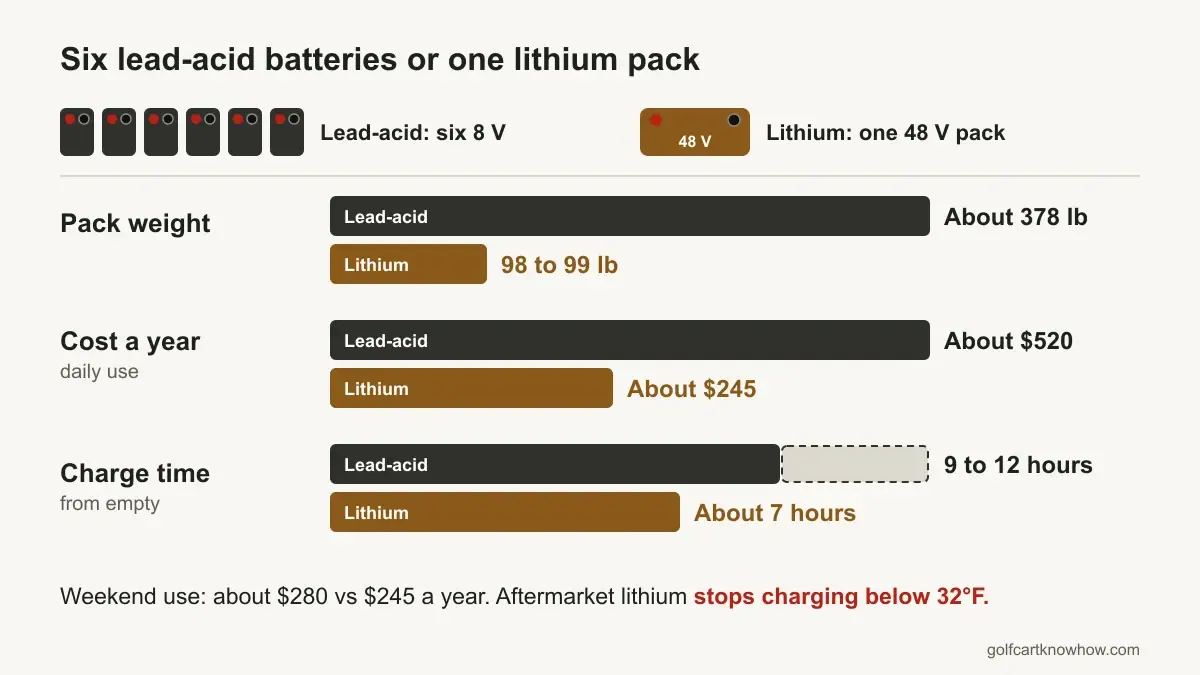
At a glance
- Weight: one 48 V lithium pack is about 100 lb against roughly 378 lb for six 8 V flooded batteries.
- Cost per year: lithium works out near $200 to $245, lead-acid near $280 to $470, calculated below.
- The catch: no aftermarket lithium pack charges below freezing, and the price only pays back if you keep the cart.
On this page (6)
What a lithium pack feels like day to day
The packs sold for carts are lithium iron phosphate (LiFePO4), and the differences you notice first have nothing to do with cycle ratings. One pack replaces the six batteries you now lift, carry and water, and it charges in roughly half the time. What you lose is cold-weather charging and the margin of a chemistry your cart was wired for. The figures below come from the makers' own sheets, and the voltages and pack layouts behind them apply to any 48 V cart.
| Six 8 V flooded | One 48 V 105 Ah lithium | |
|---|---|---|
| Pack weight | about 378 lb (six Trojan T-875 at 63 lb, calculated) | 98 lb (Eco), 99 lb (Dakota), 101 lb (RoyPow) |
| Watering | check the fluid monthly | none |
| Charge from empty | 9 to 12 hours | about 7 hours at 15 A |
| Equalizing | once a month when in regular use | none |
| Charging in the cold | down to 0°F (-18°C) | stops below 32°F (0°C) |
The lead-acid column is from U.S. Battery's 8VGC data sheet, the charge time from Eco Battery's rule of pack amp-hours divided by charger amps. Lighter does not mean faster: the controller still sets your top speed.
The cart feels like the acceleration has slightly improved, but the top end is now 19.8. Why would I lose 1 mph with less weight and a better battery?
A 2011 Club Car Precedent owner on a stock controller, Cartaholics, 2025
What each one costs per year
A flooded pack ends in one of two ways, whichever comes first: cycles used up, or age. U.S. Battery's chart gives about 675 cycles when each discharge goes to 80 percent of the 20-hour capacity, and Interstate puts golf cart batteries at 3 to 5 years. Dakota Lithium rates its 48 V 105 Ah pack at 3,000 cycles to full discharge and warrants it for 11 years, which is the cap below, since no maker publishes a calendar life for lithium.
| Six 8 V flooded | 48 V 105 Ah lithium | |
|---|---|---|
| Pack price, checked October 2026 | $234.95 each, $1,410 for six (calculated) | $2,178 (Eco), $2,699 (Dakota) |
| Weekend use, about 100 charges a year | 3 to 5 years, about $280 to $470 a year | 11 years, about $200 to $245 a year |
| Daily use, about 250 charges a year | under 3 years, about $470 a year | 11 years, about $200 to $245 a year |
Those yearly figures are calculated from the prices above. At 250 charges a year the 675 cycles run out before the age range does; at 100 a year age ends the pack first. They also assume you keep the cart that long: sell in four years and the lithium pack cost you about $545 a year, while the flooded set cost about $350. Left out are a lithium charger if your pack does not include one, and how deep you actually run each charge.
Worth knowing: at 100 charges a year a flooded pack would need nearly seven years to use its 675 cycles, but Interstate's 3 to 5 years arrives first. Low-use owners pay for cycles they never get to use.
What else has to change if you switch
Changing chemistry changes the charging system, not just the box under the seat. Budget for a lithium charger, a state-of-charge meter (the factory gauge reads lead-acid voltage), cart-specific brackets and a charge port, and a 12 V DC-to-DC converter if the cart runs lights or a stereo. Most pack makers require their own charger and tie the warranty to it: Eco Battery says a third-party charger will void it, and Dakota Lithium says a lead-acid charger fills a lithium pack to only 60 to 80 percent. What each maker puts in the box, and the order it goes on, is on the conversion kit page. Pulling cables off a live 48 V pack and rewiring the charge port is dealer work if you have not done it before.
Will it fit your cart and your charger?
Drop-in means the maker sells a bundle built for your cart, not that any pack fits any cart. Eco publishes install guides for the E-Z-GO TXT (1994 to 2008), the RXV (2008 on), the Club Car Precedent, Onward and Tempo (2004 on) and the Yamaha Drive (2011 on); the RXV and Yamaha bundles include a mounting bracket, the TXT and Club Car packs do not.
On a Club Car the onboard computer that managed lead-acid charging is the open question. Eco says no bypass is needed when its own charger is used; RoyPow's conversion guide says the Precedent's computer must be bypassed with a jumper harness. The answer follows the charger you buy, so settle it with the pack maker before you order. On an RXV, regenerative braking feeds power back into the pack, so confirm the pack's management board accepts it. Your own numbers are on the battery labels under the seat, the serial plate and the charger label.
Worth knowing: cycle ratings are quoted at different depths of discharge. Dakota prints 3,000 cycles at full discharge and 6,000 or more at 80 percent, so a bigger headline number does not automatically mean a longer life.
When lead-acid is still the right buy
The cart winters cold. Every aftermarket pack above stops charging below 32°F, because charging a frozen cell plates lithium metal inside it and ruins it. Flooded batteries charge down to about 0°F, and Trojan asks only that a pack kept below freezing stays above 60 percent charge. Factory lithium is the exception: E-Z-GO's ELiTE manual allows charging down to -4°F ambient, and Eco's heated Gen3 packs charge below freezing.
You barely drive it. A few charges a month never reach the cycle count that makes lithium cheap, and the pack's warranty years outlast your interest in the cart.
The cart is worth less than the pack. On a twenty-year-old body, $2,178 of battery is money the resale price will not return.
It's not the end of the world though, as given my particular circumstances, lead-acid may be a better choice at less than 1/3 the cost.
A Club Car DS owner whose lithium drop-in did not fit the compartment, Talk of The Villages, 2022
Common questions
How long do lithium golf cart batteries last?
On a 48 V 105 Ah pack, Dakota rates 3,000 cycles to full discharge, RoyPow 3,500 or more for the S51105P-A and 4,000 or more for the S51105L-Z. Warranty terms run from Dakota's 11 years to limited lifetime from Eco and RoyPow in the United States.
Can I leave a lithium golf cart plugged in all the time?
Eco Battery says leaving its charger plugged in is fine if the cart will be used soon, which lets the management board balance the cells, but to disconnect it if the cart will sit for more than a few days. Its charger FAQ recommends unplugging once the pack is full.
Will one lithium battery replace all six 8 V batteries?
On a 48 V cart, yes: a single 48 V 105 Ah pack of about 100 lb takes the place of six 8 V flooded batteries, provided you buy the bundle built for your model with its charger, meter and charge port.