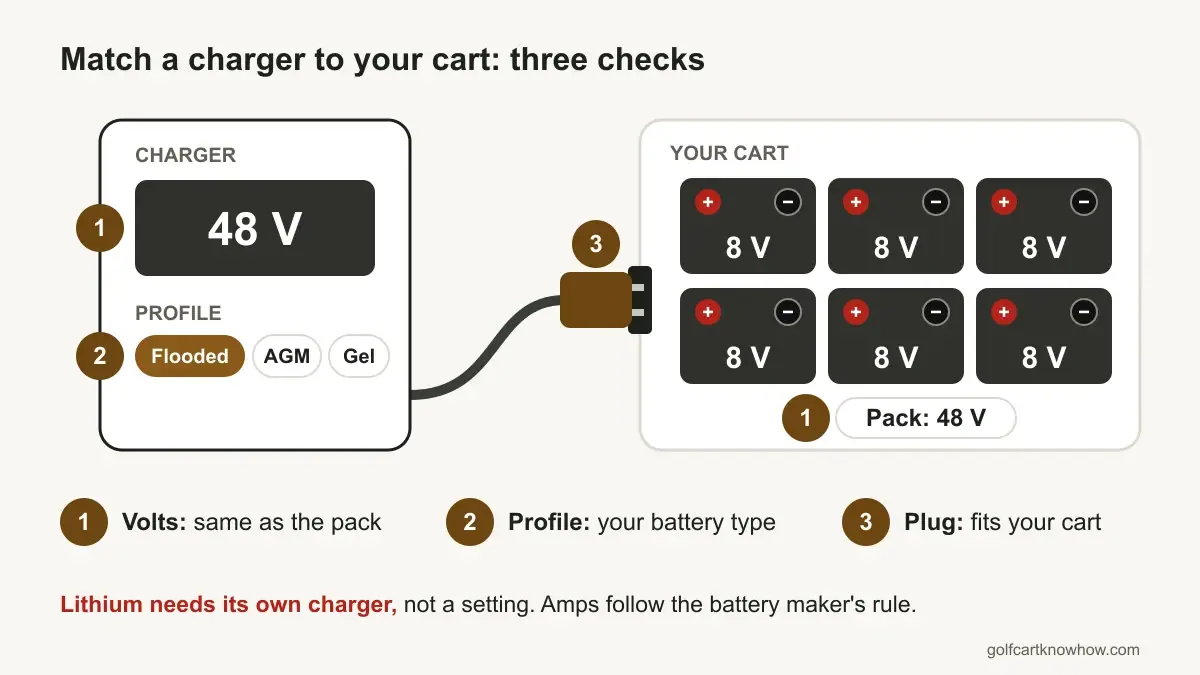
Your charger quit, or a new set of batteries is going under the seat and every listing looks the same. Three things on your cart decide which charger is right: the pack voltage, the battery type and the plug at the charging socket. The labels on the cart and the charger tell you all three.
Golf Cart Battery Chargers Explained: Voltage, Amps and Plugs
Some links on this site are affiliate links: if you buy through them we earn a commission, at no extra cost to you. As an Amazon Associate we earn from qualifying purchases.
At a glance
- Match three things: pack voltage, battery type and the plug on the cart.
- Voltage is not negotiable: Club Car warns that a pack the charger is not rated for overheats it and burns out the transformer.
- Amps: no cart maker publishes a sizing rule, but Trojan does for flooded batteries.
On this page (6)
Our picks
- E-Z-GO RXV or TXT, 48 V: FORM 48 V 15 A charger, triangle plug
- Club Car Precedent or DS, 48 V: FORM 48 V 15 A charger, circle plug
- Yamaha G29, Drive or Drive2, 48 V: FORM 48 V 15 A charger
- Club Car, 36 V or 48 V pack: Lester Summit Series II 650 W
What kind of charger does a golf cart use?
An automatic one. It takes household AC power, runs the pack through a set charge profile and shuts off when the batteries are full, so you are not watching a gauge. The stages are the same idea on every brand: a constant current that does most of the work, a constant voltage stage that evens the cells out, then a gentle finishing stage.
What differs is the profile, and it has to suit the batteries you actually own. Trojan tells owners to confirm the charger is set to the program for flooded, AGM or gel before charging; a Delta-Q QuiQ picks a numbered algorithm to suit the battery make and size, and the charger on Yamaha's 2025 Drive2 arrives preset to algorithm #93 for Trojan 48 V batteries.
Chargers also come in two shapes. Lester calls a shelf or floor unit off-board, and an on-board charger is bolted to the cart and starts when you plug the AC cord in. Yamaha's own charger is not designed for on-board mounting.
Does the charger have to match my voltage, and how many amps?
The voltage has to match, with no exceptions. E-Z-GO's PowerWise QE manual says to use that charger only on 48 volt battery systems, Yamaha says to use only chargers rated for 48-volt Yamaha carts, and Club Car warns that a pack not compatible with the charger's DC output overheats it and burns out the transformer. Your pack voltage is on the batteries themselves: read the voltage on one label under the seat and multiply by the number of batteries.
Amps decide how fast it charges, not whether it works, and no cart maker prints a sizing rule. The battery makers do. Trojan puts the first stage at 10 to 13 percent of a flooded battery's 20-hour capacity, which is the amp-hour figure on the label; Dakota keeps the charger at a third of the pack's amp-hours or less on its lithium packs. Here is what the factory chargers print on their own labels:
| Charger | Pack | DC output | AC draw |
|---|---|---|---|
| E-Z-GO TXT 48 factory charger | 48 V | 13 A | 8 A at 120 V |
| Yamaha Drive2 charger | 48 V | 18 A max | 10 A at 120 V |
| Club Car E.R.I.C. | not printed | 13 A | 7.5 A max |
| FORM Charge 48 V | 48 V | 15 A | not printed |
The E.R.I.C. figures come from Club Car's fleet sell sheet.
Which plug does my cart take?
On an E-Z-GO TXT the receptacle is on the driver's side just below the seat bottom; on any cart it is the socket the old charger's cord plugged into, so check there first. The cart makers never name the shapes (E-Z-GO's TXT guide just calls it a polarized connector, and PowerWise is the name of an E-Z-GO charger, not a plug), so the names in listings come from the charger makers. Lester's cordset table lists the "E-Z-GO PowerWise 2-Pin", the "E-Z-GO 3-Pin Molded RXV & 48V TXT", the "Club Car 3-Pin Molded", the "Yamaha 2-Pin" and the two-blade "Crowsfoot"; FORM Charge sells the E-Z-GO 3-pin as the "EZGO Triangle Plug" and the Club Car 3-pin as the "Club Car Circle Plug".
In buying terms, an RXV from 2008 on or a TXT from 2014 on takes the FORM triangle-plug charger, a DS from 1994 on or a Precedent from 2004 on takes the circle-plug version, a G29, Drive or Drive2 takes the Yamaha one, and the Lester Summit Series II 650 W ships with the Club Car 3-pin cordset. Year by year, the fit is on the E-Z-GO charger page and the Yamaha charger page.
Tip: A rattle inside an E-Z-GO charger plug is not a broken part. E-Z-GO's TXT guide says it is a magnet in the plug body, part of the interlock that keeps the cart from being driven away while the charger is connected.
Is a lithium charger different?
Yes, and it is the profile that differs rather than the plug. Trojan's flooded 48 V batteries want a bulk voltage around 59 V, while its lithium OnePack wants a lithium-ion profile set between 54.7 V and 56.0 V, so a lead-acid charger finishes in the wrong place on a lithium pack. Several pack makers go further and require their own charger. If you are converting or have already converted, the lithium charger page covers whose chargers each maker allows.
Where to plug it in, and how to set it up
Give the charger a circuit of its own. E-Z-GO asks for a dedicated 15 A circuit per charger with nothing else plugged into it, Yamaha asks for a line that can supply 12 A and 15 A branch protection and says not to share it with another device, and Club Car allows two of its E.R.I.C. chargers on one 20 A circuit. A dedicated 15 A circuit with nothing else on it meets all three rules: it carries Yamaha's 12 A, and it is what E-Z-GO and Club Car ask for.
- Use a grounded outlet as it is. No ground adapters, no modified plug, and a ground-fault (GFCI) outlet anywhere damp.
- Stand a portable charger on a shelf or platform with air around it, out of rain and sun.
- Charge lead-acid batteries where the air moves: E-Z-GO and Yamaha both want at least five air changes an hour, because charging makes hydrogen and it is explosive at 4 percent. Keep it away from a gas water heater or furnace.
- To stop a charge early, pull the AC cord first, then the DC plug. Yanking the DC plug while the charger is running can arc.
If the AC cord is damaged, or the charger has been dropped or taken a sharp blow, it goes to qualified repair personnel rather than back into the outlet. Extension cords are a per-charger rule, and the makers do not agree:
| Charger | Cord it allows |
|---|---|
| E-Z-GO PowerWise QE | 14 AWG, up to 50 ft |
| Yamaha Drive2 | 12 AWG, up to 50 ft |
| Lester Summit II 650 W | 14 AWG, up to 25 ft |
| Delta-Q QuiQ | 10 AWG to 100 ft, or 16 AWG to 25 ft |
| Eco Battery | 12 to 14 AWG to 15 ft, 10 to 12 AWG to 25 ft |
Follow the one printed for the charger in your hand.
Tip: If a shop fits an E-Z-GO 3-pin cordset to a Lester charger in the field, a new System Profile has to be uploaded through the ChargerConnect app, or the lockout that stops you driving off while plugged in will not work.
Common questions
Can one charger charge both a 36 V and a 48 V golf cart?
Some can. Lester's Summit Series II 650 W 48 V and 36 V models have Auto Voltage Mode, which detects the pack and adjusts with no setting changed; the 1050 W models add 24 V. Lester still says to check the active battery profile before charging a different pack.
Do the flash codes mean the same thing on every charger?
No. Each charger maker writes its own codes, and some lights are not faults at all: a Delta-Q QuiQ flashes its algorithm number when no battery is connected, and Yamaha's 2025 charger flashes the 80 percent LED to show algorithm #93. Read the chart in that charger's own manual.
Do I need a different charger setting after I change my batteries?
If the type or the capacity changed, yes. Trojan says to set the charger to the program for flooded, AGM or gel before charging, and a Delta-Q or Lester charger holds several profiles chosen by battery make and amp-hours. A dealer or the charger's app makes the change.