Your cart clicks when you press the pedal and goes nowhere, or it does not click at all, and the forums all point at the solenoid. Sometimes they are right. The solenoid is the heavy switch that connects your battery pack to the controller when you press the pedal, and cuts it off when you lift your foot.
Golf Cart Solenoid: Signs It Has Failed, the Makers' Tests, and Choosing a Replacement
At a glance
- What it does: It connects the pack to the controller on the pedal and is the cart's emergency disconnect.
- The one check you can do: Key on, direction set, wheels clear, listen for a click.
- The rest is live-voltage work: Voltage and coil tests belong to a technician.
On this page (5)
What the solenoid does on an electric cart
Press the pedal and a small circuit through the key switch and the pedal switch energizes the solenoid's coil, pulling two heavy contacts together so pack current can reach the controller. Lift your foot and they open. Alltrax calls it a contactor, "sometimes called a solenoid", and Curtis calls it the main contactor; it is the part that disconnects the battery if the motor or controller fails.
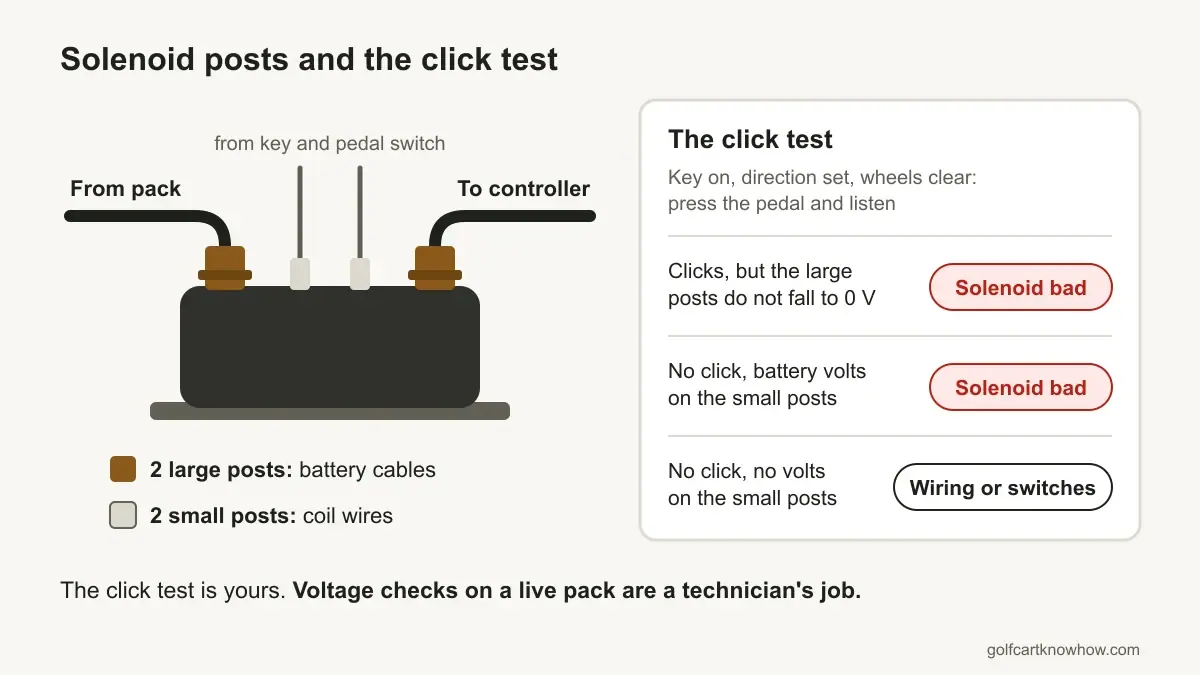
Look under the seat and you will see four terminals: two large posts carrying the battery cables, two small ones for the coil wires. A diode sits across the small terminals to soak up the voltage spike when the coil switches off, and some controllers add a pre-charge resistor across the large posts.
Go looking in your E-Z-GO owner's guide and you will not find the part described at all, so everything here comes from the controller makers. If your cart runs on gas, the solenoid under the seat is a starter solenoid doing a different job, covered on the gas cart will-not-start checks. For whole-cart triage before you blame any one part, start with the electric cart that will not move.
How do I know if my solenoid is bad?
Three things put the solenoid in the frame: silence, a click with no movement, or power that stays on after your foot comes off. Each one has a different next step, and the rows below come from the controller makers' own tables. Codes belong only to the controller family listed; never carry one across brands.
| What you notice | What the makers say | Source |
|---|---|---|
| No click with the key on, direction set, pedal pressed | First thing to check; if it will not close, go to the solenoid tests | Alltrax, Navitas |
| Clicks, cart still will not move | If voltage across the large terminals does not fall to zero, replace it | Navitas 2-2 |
| Cart stays powered after you lift your foot | Welded or stuck solenoid | Alltrax 1G6R, Curtis 3,2, Navitas 2-8 |
| Controller reads low voltage, batteries read fine | Voltage drops at the controller but not the pack: solenoid suspect | Navitas 3-1 |
| Controller throws a coil or relay fault instead of moving | Coil drawing too much current: shorted coil, wires on the wrong terminals, or a backwards suppression diode; coil resistance is measured across the small terminals | Navitas 2-4, Alltrax AC1 3G3R |
| Violent jerking when you press the pedal while rolling (E-Z-GO PDS or DCS) | Check or replace the diode on the small terminals | Alltrax TN014 |
Why they fail: stock 70 and 100 A solenoids use plain copper contacts with no plating, and Alltrax says those arc, pit and carbon up when they are run behind a high-current controller and motor. A coil voltage that does not match your pack will not hold the contacts closed, and too much voltage cooks the coil.
Tip: That PDS jerk is not the controller going bad. A missing or backwards diode on the small terminals lets through a spike Alltrax says can exceed 150 volts, and that spike is what kills controllers.
What you can check yourself, and what you cannot
Start here, in this order (the order is ours, built from what the controller makers check first), before anyone spends money on a part.
- Charge the pack and confirm your batteries and cables first. A flat pack or a tired cable gives you the same no-go as a dead solenoid, and Navitas checks them in that order too.
- If you have just reconnected a battery or any other wiring, wait at least 30 seconds before moving the Run/Tow switch back to Run; the RXV ELiTE label says the same before you turn the key. A cart that went dead right after a battery reconnect may need nothing more than those 30 seconds.
- Key on, direction selected, drive wheels clear, press the pedal and listen for a single sharp click from under the seat.
- Look, do not touch: loose, corroded, melted or burned connections on either pair of posts.
Past that point the tests are made on a live pack with the drive wheels raised, and that is a technician's job. Navitas prints four:
- Voltage across the large terminals with the pedal pressed: it clicks and the voltage does not drop to zero, replace it.
- Voltage across the small terminals when there is no click: battery voltage there means the solenoid is bad, none means wiring or switches.
- Coil resistance across the small terminals with the circuit disconnected: above 48 ohms on a single coil, above 20 ohms on a double coil.
- The welded check, key off and the switch in Tow: anything but 0 V across the large terminals.
On a Club Car, rule out the on-board computer before condemning the solenoid: Alltrax lists a reboot of the OBC ahead of replacing the part. Never bypass or re-wire a switch or the controller to get moving; Navitas says so in plain words.
Which solenoid do I need?
You can buy the part, but a shop should fit it: no cart maker prints an owner procedure for it. A replacement has to match on four things:
- Coil voltage to your pack. Under-fed, the coil will not hold the contacts; over-fed, it burns.
- Amp rating to your controller. Alltrax calls stock units 70 or 100 A, wants 100 A behind a 300 A controller, suggests a heavy-duty 200 A with an upgrade, and requires 400 A continuous with its AC1. Never a stock 70 A behind an Alltrax controller.
- Terminal count, which on these carts is almost always four.
- Diode and pre-charge resistor. Controller-dependent: Alltrax SR takes a resistor sized by pack voltage, XCT and NCT take none, Navitas tells you to remove both.
A large parts retailer lists a 48 V four-terminal solenoid for E-Z-GO TXT 2010 on and for Club Car DS and Precedent 2000 on, but that is a retailer's fitment line, not the cart maker's parts list: check it against the part you pull off. Before anything comes off the posts:
- Key off and removed.
- Run/Tow switch to Tow.
- Main negative cable off first.
- Then the main positive cable, and never disconnect a circuit under load.
- Wait 30 seconds after reconnecting before going back to Run.
E-Z-GO says repairs are for trained and qualified personnel, and that includes this one. Whether to upgrade the controller at the same time belongs to the controller guide, and your cart's own circuit is on its wiring diagram.
Tip: Alltrax puts stock solenoids at 70 or 100 A, one large retailer says around 150 A, and no cart maker publishes a figure at all. The only number you can trust is the one printed on the label of the part you pull off.
Common questions
Can I bypass the solenoid on my golf cart?
No. Navitas states plainly that you should never re-wire, bypass or change wires, switches or the controller, and to call a dealer instead. Bypassing removes the cart's emergency disconnect, which is the one job the solenoid cannot stop doing.
Can a bad solenoid damage the controller?
Yes. A missing or reversed coil diode lets a spike Alltrax says can exceed 150 volts travel back into the controller and cause permanent damage. An undersized solenoid behind a big controller can also weld shut and take the controller with it.
How often should a golf cart solenoid be replaced?
Your cart's maker does not print an interval for it. Alltrax, for its own installs, puts solenoid replacement on a preventative maintenance plan every 3 to 5 years, treating it as a wear part because the contacts arc and pit each time they close.