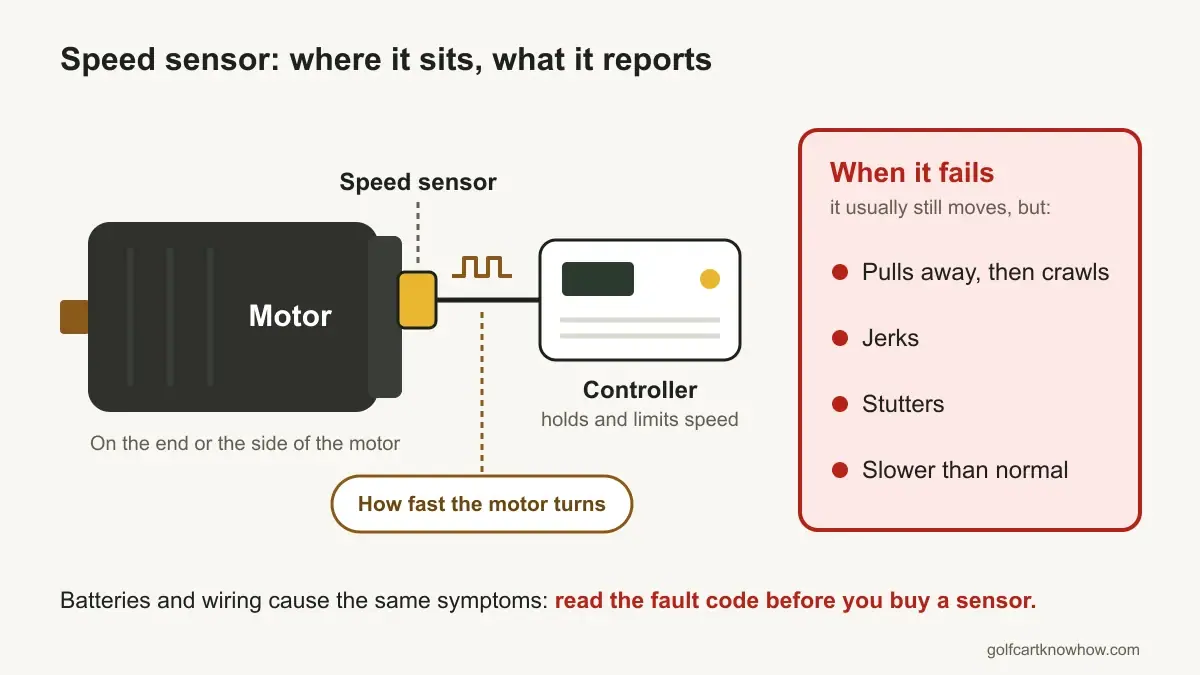
Your cart pulls away like it always did, then levels out at a crawl a few seconds later. Discharged batteries, a tired motor and a faulty throttle sit on the same maker's list, which is why the sensor is usually the last thing checked. On nearly every electric cart it sits on the motor and tells the controller how fast the motor is turning.
Golf Cart Speed Sensor: Symptoms, How It Is Tested, and Who Replaces It
On this page (5)
What does the speed sensor do, and does your cart have one?
The controller uses the motor speed reading to hold and limit how fast you go. Where the sensor sits depends on what drives your cart:
- Shunt DC carts (separately excited motors): a small group of wires on the end of the motor, reading a 4 or 8 pole magnet bolted to the armature. Alltrax says most separately excited motors come with one, and names the E-Z-GO DCS and the old Club Car Regen 1 and 2 carts as the exceptions.
- Carts running a Curtis 1268 controller: a Hall effect sensor wired through a six pin connector.
- AC carts: a sensor on the side of the motor. Speed sensors are required for all AC induction applications, and every cart that came with an AC motor is equipped for one. On an AC drive the controller also uses it to tell whether the cart is rolling with no throttle.
E-Z-GO's ELiTE manual says only that the speed of the motor is sensed and controlled by the controller, with no sensor named and no test. It is also not the pedal sensor: E-Z-GO's inductive throttle sensor and Club Car's MCOR sit at the accelerator. Which motor you have decides which sensor you have, and the motor types split the same way.
Tip: Look at the motor, not the wheels. Every sensor named in these controller manuals sits on the motor, even though the Navitas app calls the setting "wheel speed sensor".
What are the symptoms of a bad speed sensor?
| What you notice | What the maker's document says | Controller family |
|---|---|---|
| Takes off strong, then levels out at a very slow speed | Sensor missing or broken | Alltrax XCT (shunt DC) |
| Jerking, rough feeling throttle | Can be sensor related | Alltrax XCT |
| Feels like half speed while the monitor shows full motor rpm | Wrong 4 or 8 pole setting | Alltrax XCT |
| Slower than normal | Faulty speed sensor, listed beside discharged batteries, a damaged motor and a faulty throttle | Navitas TAC 2 (AC) |
| Stutters | Sensor wires crossed, or the sensor does not work | Navitas TAC 2 |
| Flash codes 4-8, 4-9, 4-12 | Encoder input not changing when motor current is applied | Navitas TAC 2 |
| Codes 1,3 and 1,5 | No pulses from the sensor; defective sensor among the stall causes | Curtis 1268 |
| One green, five red flashes | Throttle power fault, triggered when the speed sensor is damaged | Alltrax AC1 |
No maker says how often the sensor is the cause, and every one of those lists puts batteries, wiring and the throttle beside it. If the cart barely responds at all, work through the first checks for a cart that will not move before you order a part.
How is a golf cart speed sensor tested?
Every published test needs a tool. The one check you can do with your hands, which is ours rather than a maker's: key off, Run/Tow switch in Tow, then look at the sensor plug at the motor for a connector that is loose, wet, corroded or damaged.
- Alltrax XCT, with a laptop: uncheck the speed limit box in the Alltrax Toolkit so the controller ignores the sensor. If the symptom stops, the sensor or its magnet is the part to replace. The Toolkit monitor also shows whether the controller sees any motor rpm.
- Navitas TAC 2, with a meter and the app: key off and the cart in Tow, unplug the four pin encoder harness at the motor. With the key on in Run, the pins should read about 5 V, 3 V, 3 V and 0 V. The app's diagnostics page shows whether the input responds, which is as far as you should go without help: Navitas reserves servicing of its controllers for a trained golf car technician.
- Curtis 1268: the controller flags the speed sensor fault itself when it sees no pulses.
E-Z-GO and Club Car publish no owner test for this part, so on a cart with its stock controller the code reading belongs to a dealer. Knowing which controller you have decides which test applies.
Tip: On a Curtis 1268, the 15 V supply at the sensor connector is for the speed sensor only. Do not tap it for lights, a horn or a USB socket.
Can you replace it yourself?
Do this before anything comes off the motor:
- Key off and removed, parking brake on.
- Run/Tow switch to Tow. On a TXT, it goes to Tow before you disconnect or connect a battery or any wiring, and waits at least 30 seconds after reconnecting before going back to Run.
- Drive wheels off the ground on jack stands.
- Pack disconnected, positive and negative, while parts are removed.
On a shunt DC cart the repair is the sensor or its magnet; on a Navitas AC drive you pull the encoder, clear any debris and reset it. Neither prints removal steps or a torque figure, so the fit of the part is what you check. A parts retailer lists a motor speed sensor kit for 2004 and later Club Car DS and Precedent electric carts with two magnet styles: one motor case where the sensor pops in behind a snap ring, one where it screws to the end cap.
Anything past that plug is technician work. E-Z-GO keeps major repair in the technician's manual and asks that only qualified personnel service the cart.
Common questions
Why does my golf cart go the wrong way after a controller change?
On a Navitas AC conversion that moves smoothly but backwards, the fix is in the app. Navitas says to switch both Change Wheel Speed Sensor Direction and Change Motor Direction, and that both are off for a Club Car, whose rear axle is mounted opposite to an E-Z-GO TXT.
Can I drive my golf cart with a bad speed sensor?
No maker publishes an answer, and it depends on your controller. An Alltrax XCT keeps looking for the sensor unless the speed limit box is unchecked in the Toolkit, and an AC drive requires the sensor.