You have the seat up, a battery disconnected, and a job that needs the factory wiring diagram. Here is the part nobody tells you: only Yamaha prints one in the owner's manual. E-Z-GO and Club Car keep theirs in the technician's manual, and most diagrams you find online are controller makers' drawings, not your cart's factory harness.
Golf Cart Wiring Diagrams: Where to Get the Official One and How Each Brand Wires Its Pack
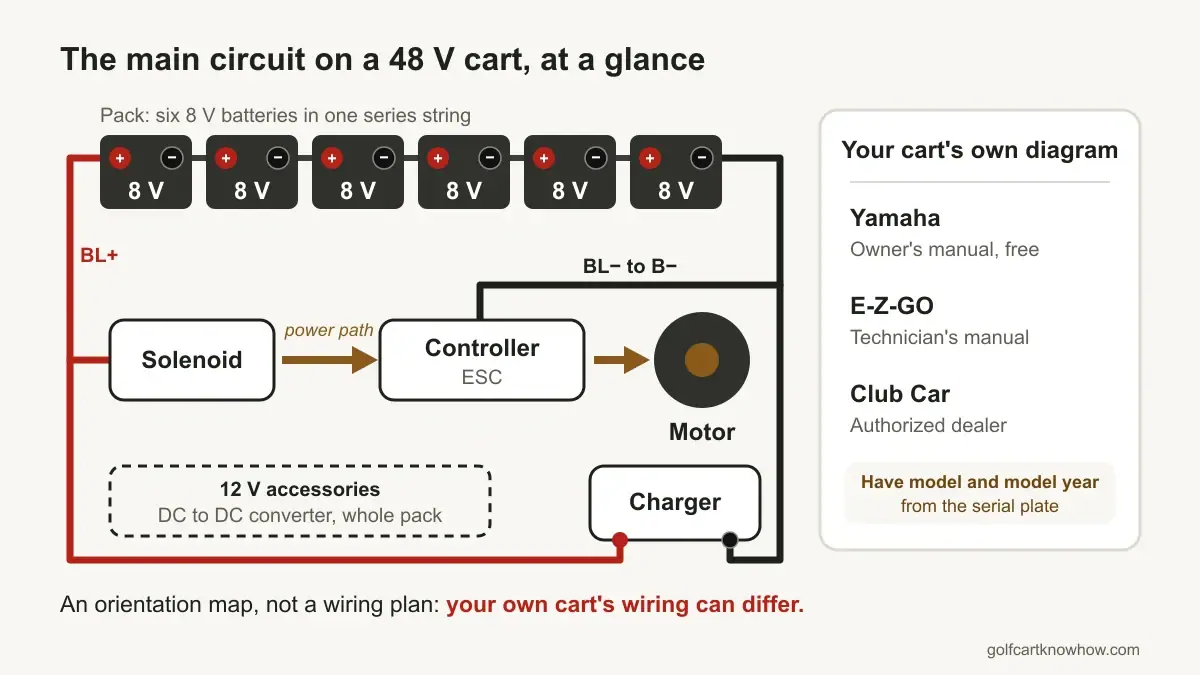
At a glance
- Yamaha owners get one free: every Yamaha owner's manual read, gas and electric, has a Wiring chapter with a diagram page.
- E-Z-GO and Club Car do not: the diagram lives in the service manual, bought through a dealer or distributor.
- Online diagrams are conversion drawings: they show a replacement controller and a fused pack, not your stock wiring.
On this page (5)
Where to get the diagram for your make
What you can get depends entirely on the badge on the front. Find your model and year first from the serial plate, then work down this table. The brand pages for E-Z-GO and Yamaha show where that plate sits on each model.
| Maker | Where the factory diagram is | What you can get |
|---|---|---|
| Yamaha | Wiring chapter of the owner's manual | The diagram itself, free from Yamaha's manual library, from the 2000 G16, G19 and G22 manuals through the 2025 Drive2 |
| E-Z-GO | Technician's Repair and Service Manual | Buy it from a distributor, an authorized branch, the E-Z-GO parts department or shopezgo.com; the owner's manuals page lists owner's manuals only |
| Club Car | Vehicle maintenance and service manual | Contact an authorized Club Car dealer; the public manuals search offers operator's manuals and warranty statements |
| Evolution, ICON, Kandi | Not stated | No diagram in the owner's manuals and no stated route to one; Kandi sends diagnosis to a dealer or service center |
Worth knowing: Yamaha prints the diagram for gas carts too. The 2016 gas Drive manual's Wiring chapter keys the ECU, main relay, reverse alarm, starter generator and voltage regulator, so a gas owner chasing a no-start has the same drawing an electric owner gets.
How many batteries your pack holds
The count under your seat tells you the pack voltage, and it varies inside a single brand: an E-Z-GO TXT 48 carries six 8 V batteries, while the Valor carries four 12 V. Yamaha's own 2027 Drive2 PowerTech AC page lists six 8 V as standard and eight 6 V as an option on the same 48 V cart.
Count yours and read the label on one battery. The arithmetic and the layout per model belong to the page on 6 V, 8 V and 12 V battery configurations and the brand battery pages.
Are the free diagrams online the real thing?
Mostly not. The drawings that fill search results come from the two controller makers, and they exist to show you how to fit their controller:
- Alltrax XCT and NCT installation drawings: E-Z-GO DCS, PDS and TXT 48; Club Car IQ, Precedent and i2; Yamaha G19, G22 and YDRE
- Alltrax AC1 drawings and schematics: Club Car IQ and Precedent, plus the RXV
- Navitas TAC 2 Appendix A battery pack wiring diagrams: RXV by era, TXT 48 conversion, Precedent 2014 conversion, Yamaha YDRE2 and G29 conversion
- Navitas DC manual install pages: Precedent 48 V, TXT 48 V, TXT 36 V, G19 and G22 48 V, Drive 48 V
Each shows the pack wired to that maker's replacement controller with a fuse, not your cart's factory harness, so the stock wiring can differ. They are still useful for understanding what the controller does and how the big and small terminals on the golf cart solenoid are fed. The one factory-labelled wiring figure in E-Z-GO's TXT 48 owner's guide is the battery connections drawing, which marks BL+ to Solenoid, To Charger, and BL- to B- on ESC.
Reading the diagram and working safely
A Yamaha diagram is two things side by side: a numbered component key (main switch, tow/storage switch, accelerator stop switch, buzzer, directional switch, DC motor, controller, throttle sensor, relay, receptacle, fuse, batteries) and a wire color code. In the G22E manual that code reads B black, L blue, G green, Y yellow, R red, P pink, Br brown and W white, with two letters for a striped wire. Newer Yamaha diagrams are drawings only, so read them from the PDF rather than a printed copy.
Then follow the makers' order before you touch a cable:
- Key off and removed. E-Z-GO warns that an electrical arc or battery explosion can occur if the key is not off when battery wires come off or go back on.
- Run/Tow switch to Tow before connecting or disconnecting any battery or wiring. E-Z-GO says failing to do so damages the controller or motor.
- Main negative cable off first, then the positive, as the Valor manual sets out.
- Never disconnect a circuit under load at a battery terminal.
- After reconnecting, wait at least 30 seconds before turning the key.
Every accessory grounds straight to the battery negative post, never the chassis or body. Getting 12 V to lights is its own job, covered on the page for wiring 12 V lights on an electric cart.
Worth knowing: Pack cabling and series connections on a live pack are a job for a technician, and E-Z-GO's own label says only qualified personnel should service the vehicle. Navitas is blunter: installing or servicing its controller must be done by a trained golf car technician.
Common questions
Does a gas golf cart have a wiring diagram?
Yes. Yamaha prints one for its gas carts as well: the 2016 gas Drive owner's manual carries a Wiring chapter whose key names the ECU, main relay, reverse alarm switch, starter generator and voltage regulator. A gas cart runs a 12 V system, not a battery pack.
What does ESC mean on an E-Z-GO battery diagram?
ESC is E-Z-GO's abbreviation for the speed controller. On the TXT 48 battery connections figure, the label BL- to B- on ESC means the pack's main negative cable runs to the B- terminal on that controller.
Why will my cart not run right after I reconnect the batteries?
Often it is the wait. E-Z-GO's own label says to wait 30 seconds after reconnecting batteries before turning the key switch to reverse, forward or neutral, and the Run/Tow switch has to be back in Run.