Your cart sat on the charger all night, the key turns, and the pedal does nothing. The usual mistake is buying a solenoid before checking anything. An electric cart that will not move is most often being held by something the maker built in to stop it, and every one of those checks is free.
Electric Golf Cart Will Not Move: What to Check First
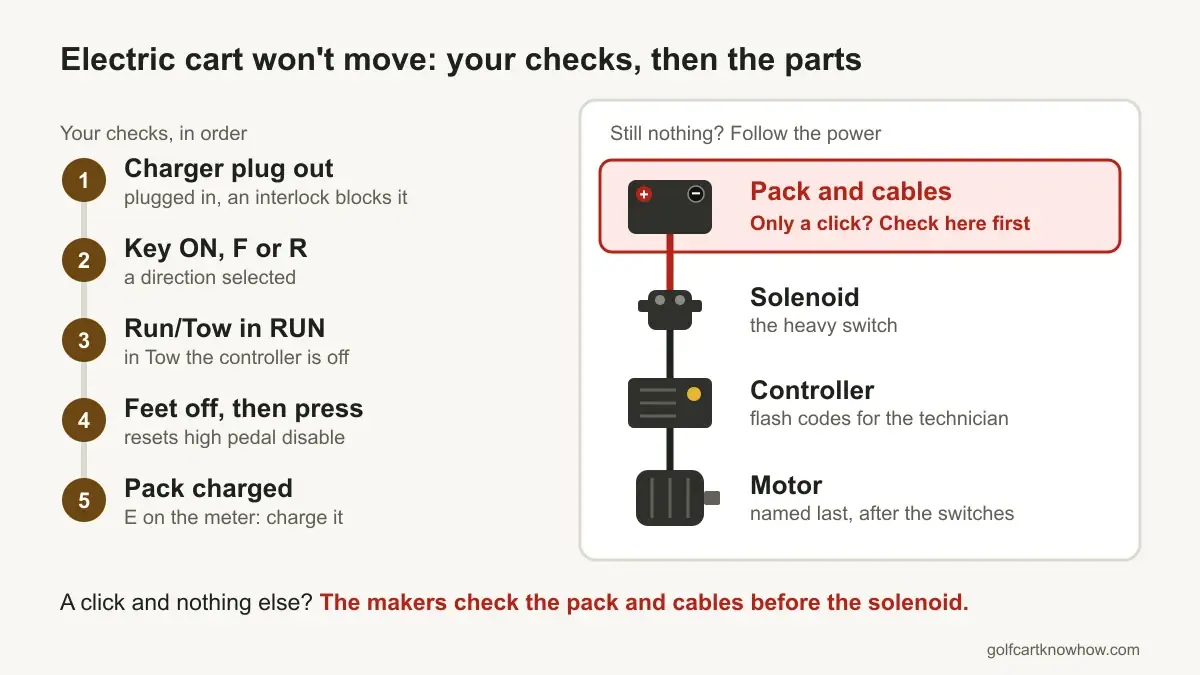
At a glance
- First five minutes: charger cord out, key on, direction selected, Run/Tow in RUN, both feet off the pedals.
- A click with nothing moving: the controller makers check the pack and its cables before they touch the solenoid.
- Where you stop: controller, motor and pack wiring are dealer work in every manual read here.
On this page (6)
What to check yourself, in order
Work through these with the key in your hand before you order a part. The order is ours, built from E-Z-GO's operating procedures for the TXT 48 (model year 2014 on) and the RXV ELiTE and Valor (2024 on) plus the controller makers' documents; no maker prints a will-not-move list, and Club Car on-board computer carts and Yamaha carts are outside what is covered here.
- Pull the charger plug out of the cart receptacle. An interlock disables the controller while the charger is connected, so a TXT 48, ELiTE or Valor will neither drive nor tow with the cord in.
- Key to ON and the direction selector in F or R. On a TXT 48 the service brake goes on first, then the park brake releases when you press the service brake pedal. Chock a wheel while you work: pressing the accelerator on a TXT 48 releases the park brake even with the key OFF, so the cart can move.
- Run/Tow switch to RUN. On a TXT 48 it sits under the passenger-side seat, and in Tow/Maintenance/Storage the controller is switched off. The ELiTE and Valor operate only in RUN.
- Clear high pedal disable: both feet off both pedals, then press the accelerator. The ELiTE and Valor reset that way; the TXT 48 guide names the feature but prints no reset.
- If it died right after battery work, wait 30 seconds after reconnecting before the key goes to F, R or N.
- Charge the pack. E on the TXT 48 state-of-charge meter means charge it, and no maker prints a pack voltage below which the cart stops, so test the batteries once they are full.
My problem was the white wire coming from the charger port became loose and caused the cart not to move.
A cart owner, Cartaholics, 2025
Full batteries and a dead cart can still be the charger circuit telling the controller it is plugged in.
Tip: The TXT 48 guide tells owners to put the Run/Tow switch back to Tow once a stalled cart has been moved. A cart that was pushed or towed at the end of last season may simply still be sitting in Tow.
It clicks, hums or does nothing: what the sound points to
The tables below are the controller makers' own: Alltrax and Navitas for carts fitted with their controllers, Curtis for OEM-type controllers. They are written for technicians, so the owner column says what is yours.
| What you notice | What the makers' tables name | Who makes the check |
|---|---|---|
| Solenoid clicks, cart stays put | Battery under voltage (Alltrax); empty or low batteries, bad batteries, loose or damaged cables, then the solenoid (Navitas code 3-1) | You charge and clean cables; the voltage test across the solenoid posts is technician work |
| Controller lights up, nothing moves | Foot switch, key switch, direction micro switches, throttle, motor (Navitas TSX 3.0); on Club Car IQ and Precedent the on-board computer, then the solenoid (Alltrax) | Technician |
| No light on the controller at all | Voltage on the key switch and Tow/Run wires, and on E-Z-GO PDS and DCS carts the reed switch in the charger port (Alltrax); wiring to controller and solenoid (Navitas) | Technician |
| Hums and quits on a slope or with the brake held | Anti-Stall cutting power to a stalled motor (E-Z-GO); motor stall, code 1,5 (Curtis) | You: lift off the pedal, because more than 3 to 4 seconds stalled damages the motor |
| Charger interlock code with the cord already out | Charger connected (Navitas code 1-3) | You check the receptacle and plug; the wiring behind it is technician work |
Rows from the Alltrax XCT/NCT troubleshooting guide, the Navitas TAC 2 guide and the Curtis 1268 manual. If the charger itself is the problem rather than the lockout, the charger checks run differently.
Tip: Navitas and Alltrax both put the batteries and their cables ahead of the solenoid in their own order. Alltrax replaces the solenoid only if the voltage across its B+ and B- posts is low while the under-voltage code is flashing.
Which part, and where the detail is
Once the free checks are done, five things can hold a cart still. The solenoid, which Curtis calls the main contactor, is the big switch the controller drives, and the controller opens it in serious faults: that is covered on the solenoid page. The controller itself can also drop a TXT 48 into a very reduced speed mode on certain electrical failures so the cart can be driven back, and a technician reads the failure in diagnostic mode.
The motor, a speed sensor (Curtis code 1,3 is no pulses; Navitas lists a faulty sensor for a slow or stuttering cart), the pack and the charger circuit make up the rest. Motor symptoms have their own page, and so does testing a tired pack.
The micro switch and solenoid have both been replaced (yesterday) and still nothing.
A 1996 E-Z-GO owner, Cartaholics, 2020
Guessed parts are the expensive way to find a loose wire.
Where the makers stop you
The TXT 48 label says only qualified personnel should service the vehicle, and the guide asks that repairs be performed by trained and qualified personnel. Turn the key off before any battery wire is disconnected or reconnected, because an electrical arc or battery explosion can occur otherwise, and never disconnect a circuit under load at a battery terminal. The Valor manual takes the main negative cable off first, then the positive.
On the RXV ELiTE, all battery pack and electrical service must be done by an authorized service facility, and only a dealer or certified technician can repair a blown BMS fuse. Navitas says installation or service of its controllers is for a trained golf car technician and that you should never re-wire, bypass or change the wires, switches or controller. Alltrax wants the drive axle on stands, batteries disconnected and insulated tools; Curtis states there are no user serviceable parts in the 1268.
Fuses are the exception. On a TXT 48 the fuse block under the driver-side seat protects some components and accessories, and you replace a blown fuse with the same type and size (15 A). The Valor manual sends a cart whose fuses keep blowing to a dealer. None of these manuals says a fuse stops the drive, so a blown fuse is not the explanation for a cart that will not move.
Moving a cart that will not move
Run/Tow switch to TOW first, every time. The TXT 48 guide wants it there before towing and before any battery or wiring work, and says the controller or motor will be damaged otherwise.
That same guide then contradicts itself: the Transporting Vehicle section allows towing only with a factory approved tow bar, one cart at no more than 12 mph, while a dash label on the cart says the vehicle is not to be towed and to consult the guide. Take the cautious reading, and never use a strap, rope or chain. On non-fleet RXV ELiTE and Valor carts, towing is for recovery only: key to N, switch to TOW, no faster than 5 mph. Fleet ELiTE carts may be towed by a golf car with an approved tow bar at up to 12 mph.
If total power loss leaves an ELiTE's IntelliBrake set and the Run/Tow switch does not release it, the manual release under the controller splash shield is for qualified trained personnel only, and the cart will move the moment it is released if the ground is not level.
Common questions
Why does my electric golf cart move only at walking pace?
On a TXT 48, certain electrical failures put the cart in a very reduced speed mode so it can be driven back for service, and a technician reads the fault in diagnostic mode. Navitas also lists discharged batteries, a faulty speed sensor or throttle and a bad motor for a cart moving slower than normal.
Can I push an electric golf cart that will not move?
A TXT 48, ELiTE or Valor rolls freely only with the Run/Tow switch in TOW, which switches off the electronic braking; on an ELiTE the key also needs to be at N. Push on level ground only, with someone at the wheel to steer and brake.
Why will my cart not move after I reconnected or replaced the batteries?
On a TXT 48 and ELiTE, wait at least 30 seconds after reconnecting before the key goes to F, R or N, and check the Run/Tow switch went back to RUN. The key must be OFF before any battery wire is touched: E-Z-GO warns of an arc or battery explosion otherwise.