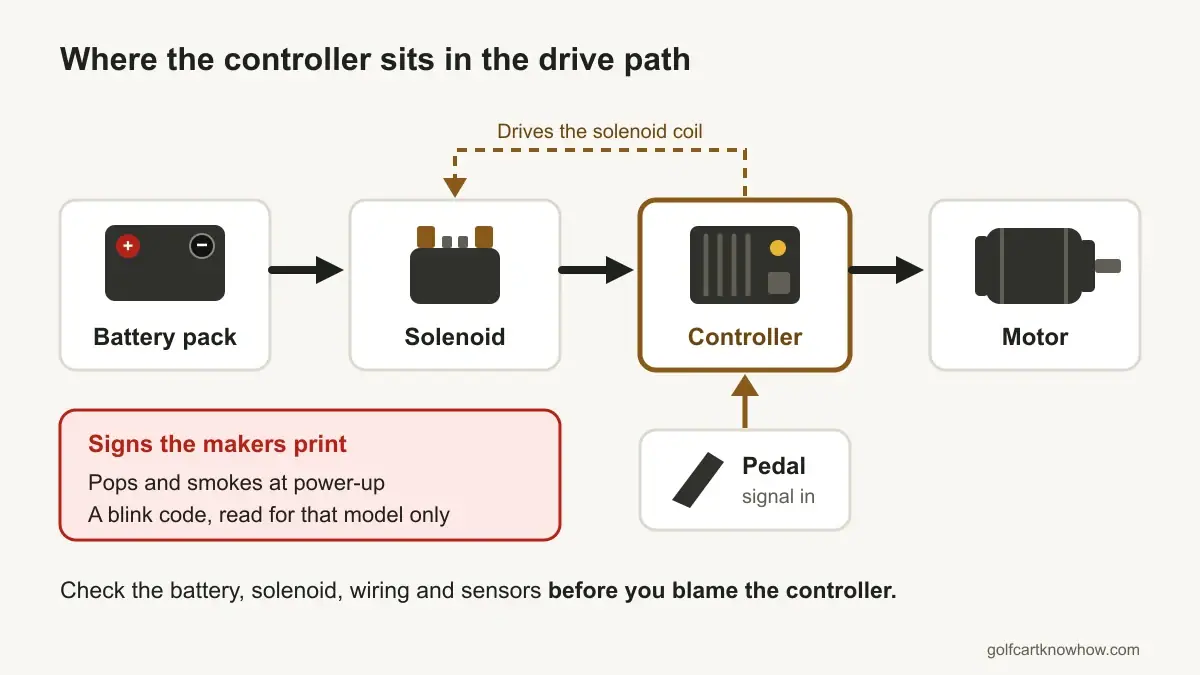
The controller is the box that reads your pedal and the forward and reverse switch and decides how much battery power reaches the motor. It sets speed, acceleration and, on newer carts, braking. Several cheaper parts fail in ways that look the same, and the controller makers say to rule those out first.
Golf Cart Controllers: What They Do, Failure Signs, and Stock vs Navitas and Alltrax
At a glance
- What it does: takes the pedal signal and decides how much power the motor gets.
- Who fits one: Navitas and Curtis both say the controller is not user serviceable, so a swap is a technician's job.
- Before you blame it: Navitas and Alltrax both list battery, solenoid, wiring and sensor checks first.
On this page (6)
What does the controller do on a golf cart?
The Curtis 1268 manual and E-Z-GO's manuals describe the job in four parts.
- Controls motor speed and torque from the throttle input. E-Z-GO's RXV ELiTE manual, model year 2024 on, puts it plainly: the speed of the motor is sensed and controlled by the controller.
- Drives the solenoid coil. Curtis requires the coil wired directly to the controller, because the controller uses that output to cut power to itself and the motor in serious faults.
- Runs regenerative braking on speed-control carts. On the RXV ELiTE, lifting off the accelerator returns motor power to the batteries, and the TXT 48 sheet lists programmable regenerative braking, acceleration and speed.
- Blocks high pedal disable: no acceleration if the key is turned on with the pedal pressed. On the ELiTE and Valor the reset is both feet on the floor, then press the accelerator.
The TXT 48 adds a diagnostic mode: after certain electrical failures it defaults to a very reduced speed so the cart can still be driven back.
Which controller does my cart have?
E-Z-GO's TXT 48 and RXV ELiTE manuals and Club Car's public specification pages name no controller maker; only E-Z-GO's Valor manual does. Apart from the Valor row, the identifications below are how the aftermarket makers label the carts they build replacements for, from the Navitas TSX 3.0 manual and the Alltrax Club Car and E-Z-GO application guides. Which family your motor belongs to, series, shunt or AC, decides which controller fits it.
| Cart and years | Stock controller, as Navitas or Alltrax identifies it | Family |
|---|---|---|
| Club Car DS, Precedent, Excel, IQ, 2001 on | Curtis 1510 or 1515, black, 16 pin connector | DC shunt |
| Club Car I2, 2008 on | Gray Curtis, 16 pin connector | DC shunt |
| Club Car Regen 2 and PD+, 1997 to 2001 | GE, 23 pin connector | DC |
| E-Z-GO TXT 48 V, 2010 on | Curtis 1206HB, black, 16 pin connector | DC shunt |
| E-Z-GO TXT 36 V | Curtis 1206MX | DC |
| E-Z-GO DCS 1997 to 2001, PDS 2001 on | Maker not named; 9 pin connector on the DCS | DC shunt |
| E-Z-GO pre-1995 Marathon, early Medalist and TXT | Maker not named by Alltrax or Navitas | DC series |
| E-Z-GO RXV | Curtis AC, Danaher on the RXV 23 | AC |
| E-Z-GO Valor, 2024 on | Curtis 1206 AC, per E-Z-GO's own Valor manual | AC |
| Yamaha Drive | Moric JW2 | DC |
E-Z-GO's own 2014 TXT 48 sheet says nothing more specific than a 250 amp solid state controller, so the label on the controller under the seat is where your answer is.
How do I know if my controller is bad?
Read a code only against the controller it came from. These are the signs the makers print.
| Symptom or code | Controller | What the maker says |
|---|---|---|
| Pops and smokes at power-up | Alltrax XCT, NCT, SR | Controller is bad. Disconnect battery power, do not power it up again, replace it and check and replace the solenoid |
| Two-digit code on the status LED, HW FAILSAFE | Curtis 1268 | Controller is defective |
| 1G1R to 1G6R blink codes | Alltrax XCT, NCT | Short circuit or output fault, under voltage, over voltage, over temperature, motor field failure, pre-charge failure |
| 1G5R, 4G3R | Alltrax AC1 | Throttle power fault, hardware failure |
| No flash code and the cart malfunctions | Navitas TAC 2 | Bench test the controller in diode mode with all wires and cables removed |
Tip: 1G5R is motor field failure on an Alltrax XCT and throttle power fault on an Alltrax AC1. The same blink pattern, two different faults, which is why a code copied from a forum post is not a diagnosis until you know the controller's model.
What looks like a bad controller, in the order the makers themselves put the checks:
- Navitas flash code 2-3: do not replace the controller until all its checks are done and the motor has been tested for short circuits. Debris or moisture on the terminals, pack voltage between B+ and B-, damaged wires, and accessories using the frame as a ground.
- Alltrax, for a slow cart: charge and load test the batteries, check the wire and solenoid sizing, and check the speed sensor is connected.
- Alltrax, on a Club Car: an on-board computer holding an uncleared fault can stop the controller powering up or the solenoid engaging, so a swapped controller looks like the fix.
Can I replace it myself?
Who may fit a controller, in the makers' own words:
- Navitas: installation or servicing must be done by a trained golf car technician, with the main positive and negative battery cables off, the Run/Tow switch in Tow, the key out, and all four wheels on jack stands. The controller is sealed and opening it voids the warranty. Never re-wire, by-pass or change the wires, switches or controller, and contact your dealer if the vehicle is not operating correctly.
- Curtis: there are no user serviceable parts in the 1268.
- E-Z-GO: repairs are for trained and qualified personnel, with major repair in the technician's manual sold through dealers.
- Alltrax: it is the installer's responsibility to ensure the correct wire, motor, solenoid and fuse are in the vehicle.
What an owner can do short of that:
- Read the blink code or status LED and write it down with the controller's make and model.
- Check the pack is charged and the terminals are clean and dry.
- Put the Run/Tow switch in Tow before any work around the pack, as the install instructions require.
The swap itself is a technician's job: it means working on live pack cabling.
Is a Navitas or Alltrax controller worth it over stock?
Published specifications by maker, not a ranking.
| Maker and line | Motor type | Pack voltage and controller amps | Programming | Warranty |
|---|---|---|---|---|
| Navitas TSX 3.0 | Shunt or series DC | 36 to 48 V, 440 A or 600 A | Factory set for shunt; series needs a firmware change in the Navitas app | 24 months |
| Navitas TAC 2 | AC induction and DC to AC conversions | 48 to 72 V, 440 A or 600 A | Navitas app | 24 months |
| Alltrax XCT, NCT | Shunt | 24 to 48 V nominal, 62 V max | Alltrax Toolkit, pre-programmed for stock carts | 2 years from manufacture |
| Alltrax SR | Series | 12 to 48 V nominal, 62 V max | Alltrax Toolkit | 2 years from manufacture |
| Alltrax AC1 | Three-phase AC conversions of TXT 48, PDS, DCS and Precedent | 48 V | Alltrax Toolkit | 2 years from manufacture |
An upgrade brings other parts with it:
- A heavier solenoid. Alltrax rates a stock 100 A unit for 300 A controllers and suggests a heavy duty 200 A instead; the AC1 requires a minimum of 400 A continuous and 800 A inrush.
- Correctly sized cable and a fused pack.
- The right field map for the motor. Alltrax says the map must be correct to keep the motor from overheating.
- The limits. Navitas factory settings assume 18 inch tires, a non-performance motor and up to 25 mph, and the controller increases torque but not cargo or towing capacity. Alltrax warns that rollover risk may be significantly higher with lift kits or larger tires. E-Z-GO says non-OEM parts may void the warranty and that it will not approve conversions to 20 mph or more.
On speed, Alltrax says a new controller can raise top speed on a shunt motor, but on a series motor it will not, which is where most plans to make a cart faster come apart.
Common questions
Can a golf cart controller be reset?
Not with a button. Alltrax says its XCT and NCT alarm codes are self clearing and repeat until the condition is corrected, and the Curtis 1268 keeps the last active code flashing for one minute after faults clear.
Do I need a new solenoid when I fit a new controller?
Alltrax says a stock 70 A or 100 A contactor used with a high-current controller is prone to arcing and pitting, and can weld closed so it cannot disconnect the pack in an emergency. It also advises replacing a solenoid every 3 to 5 years.
Can I wash my golf cart without damaging the controller?
Navitas says to keep the controller and the area around it clean and dry, and not to wash it with a direct stream or a power washer. Rinse the body and keep water away from the electronics bay.