The cart sat all winter, the lights still come on, and turning the key does nothing. Most owners reach for jumper cables at this point, which is the one thing E-Z-GO tells gas owners not to do. Work through the start sequence, the starting battery, the fuel and the spark plug instead, in that order.
Gas Golf Cart Will Not Start: What to Check First
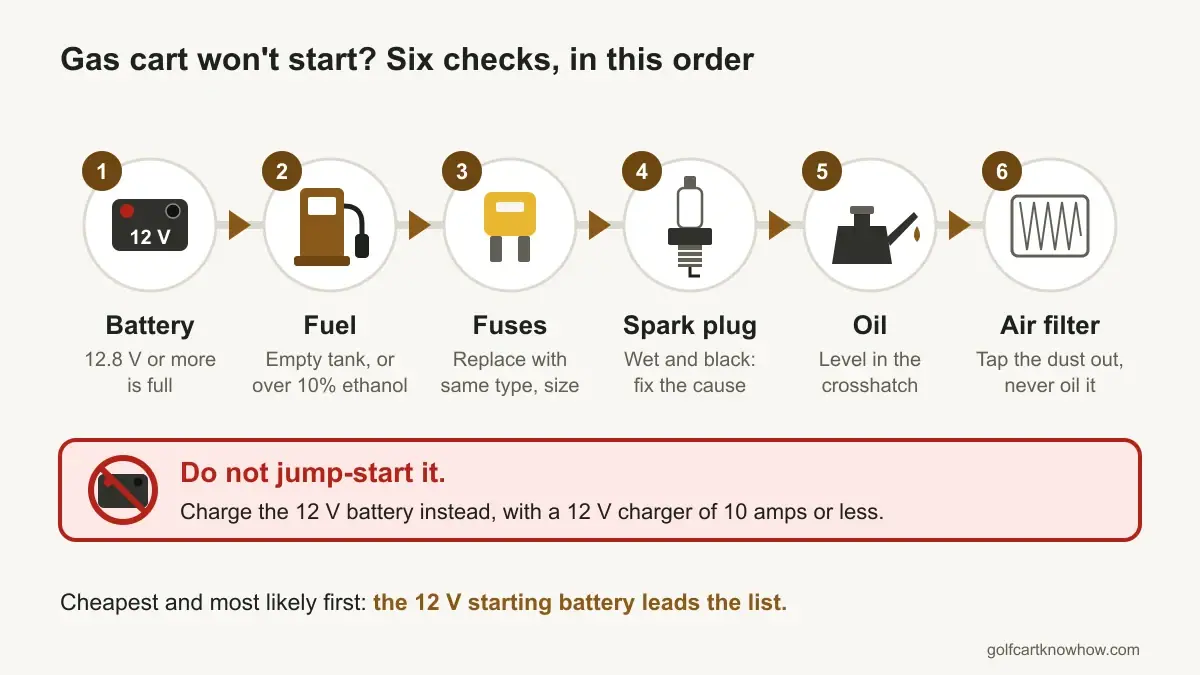
At a glance
- Start sequence first: these carts start from the accelerator pedal with a foot on the brake, not a button.
- Starting battery: on an E-Z-GO EX1 (2020-on TXT, 2024-on RXV), 12.8 V or higher is full.
- No jumper cables: E-Z-GO says the cart moves the moment the engine fires.
On this page (7)
Start it the way your maker says
The sequence is not the one a car teaches you. On an E-Z-GO EX1 (TXT from 2020, RXV, Freedom and Valor gas from 2024):
- Press and hold the brake pedal, outdoors, never in a closed garage: the exhaust is carbon monoxide.
- Turn the key to ON.
- Move the direction selector to forward or reverse.
- Press the accelerator slowly. That is what starts it. There is no start button and no choke, because the engine is fuel injected.
Keep your foot on the brake until it fires: with the key ON, pressing the accelerator also releases the park brake, and the cart can roll. When you lift off, the engine stops. That is normal, not a fault. On a Yamaha gas Drive or Drive2, set the parking brake, move the drive select lever to F or R, turn the main switch ON without touching the pedal, then press the accelerator slowly. A carbureted cart is different: the 2000 Yamaha G16A wants the choke knob pulled out and held while a cold engine starts.
Six checks you can do yourself, in order
The order is ours, and it follows Yamaha's own chart in putting fuel ahead of electrics.
- The 12 V starting battery. On an EX1, 12.8 V or higher is fully charged; below that, E-Z-GO says recharge it with a charger made for sealed batteries. Terminals clean and tight, which is a Yamaha pre-ride item. If you are unsure of the reading, here is how to check a battery with a multimeter.
- Fuel. Not empty, and regular 87 octane with no more than 10 percent ethanol and no methanol. E-Z-GO ties too much ethanol directly to poor starting.
- Fuses. Replace with the same type and size. The EX1 block is under the driver seat; on a 2025 Yamaha QuieTech the holder in the battery compartment carries a 25 A main, a 15 A light and two 10 A fuses, so go by your own fuse diagram, main switch off first. Fuses that keep blowing mean an authorized dealer.
- Spark plug, engine cold. An EX1 takes an NGK CR6HSA gapped 0.6 to 0.7 mm, torqued to 87 to 121 in lb with a light coat of anti-seize. A Yamaha gas Drive or Drive2 takes a BPR2ES gapped 0.7 to 0.8 mm at 20 N·m. Tan is normal and soot brushes off, but a wet black plug points to a dirty air filter, a bad plug wire or poor fuel: fix that cause, then fit a new plug.
- Oil in the crosshatch of the dipstick, engine warm, cart on level ground.
- Air filter: a dry cartridge, dust tapped out, no oil and no compressed air on it, replaced if heavily soiled.
What the cart's warning light is telling you
On an EX1 the check-engine light stores codes you can read yourself: lock the direction selector in neutral, then turn the key ON and OFF quickly three times.
| Code | E-Z-GO's name | Your step |
|---|---|---|
| 15 | Engine over temperature | Take it out of service, clean the CVT filter and cooling fins with compressed air |
| 31 | Crankshaft sensor malfunction | Check the connector at the sensor is not loose |
| 64 | Low oil pressure | Add oil as needed |
| 65 | Pedal switch protection | Service rep, no owner step |
| 66 | Stuck throttle protection | Check the throttle body opens fully with the pedal to the floor |
If the step does not clear the code, each one ends at an authorized service rep. Yamaha gives one lamp instead: steady means the oil is low, and a flashing light with the key on may be a fuel-injection problem, which Yamaha says is a reason not to operate the cart until a dealer has looked at it.
Worth knowing: A dark check-engine light on an EX1 does not prove there are no faults. The engine module sleeps after 10 minutes, so with the key ON and the light dark, press and release the accelerator once to wake it before you read codes.
It turns over but will not catch, or nothing happens at all
On an EX1, the one stored code that lines up with cranking and no start is 31, the crankshaft sensor, so read the light before you chase fuel. On a Yamaha gas Drive or Drive2 the printed chart starts with an empty tank: fill it, then it hands the fuel pump, a clogged fuel line, foreign matter in the fuel filter and a dirty injector to a Yamaha dealer, except that the 2016 Drive edition lets you clean the fuel filter yourself. A plug dirty with carbon or wet gets cleaned or wiped dry, and a faulty ignition is dealer work. The 2000 G16A chart adds a clogged carburetor.
For a Club Car Onward or Tempo the useful list belongs to Kohler, maker of the ECH440 engine in those carts. Cranks but will not catch:
- Blown fuses, an empty tank, bad fuel, or a clogged fuel line or filter
- A closed fuel shut-off valve or a fuel pump malfunction
- The ignition coil, the spark plug, or a disconnected plug lead
- Key or kill switch off, or an interlock switch engaged or faulty
Will not crank at all:
- A discharged battery
- The starter or solenoid, or the key switch
- An interlock, or loose and intermittently grounding wires
- Seized internals
Those are unordered lists for the bare engine; Club Car's cart wiring and interlocks sit in dealer manuals. E-Z-GO and Yamaha gas carts have no separate starter and solenoid to test, because one starter/generator does both jobs. Working lights only tell you the 12 V battery has some charge left.
Can you jump-start it?
No, not on an E-Z-GO EX1. Both EX1 manuals say do not use jumper cables to start the cart: the clutches engage the moment the engine fires, so the cart moves, and the starter/generator will not recharge a flat battery. Charge it instead with a 12 V charger rated at 10 A or less. Yamaha is shorter and firmer: if the battery loses its charge, have an experienced mechanic charge it.
The batteries are not the same part, either. An E-Z-GO RXV EX1 fleet cart carries one 12 V U1, 340 CCA with a 41 minute reserve; a 2025 Yamaha QuieTech calls for a BCI group 24 with at least 400 CCA and 75 minutes reserve. Go by the label on your own battery. Charging it is one of the few electrical steps on the owner's side of the maintenance schedule.
Worth knowing: E-Z-GO warns that heavy accessory use can flatten the 12 V battery even with the engine running. Yamaha excludes a starting battery drained by a course GPS unit, or any other parasitic draw, from warranty.
Where to stop
Stop at the plug, the oil, the air filter and the fuses. On an RXV EX1, carbon in the cylinder head, the valve seats, valve adjustment, the CVT rollers and slipper shoe and the rear axle fluid are all dealer work, and E-Z-GO adds that anyone not familiar with safe service and adjustment should hand the job to a certified dealer. On a Yamaha, leave the fuel hoses, throttle cables, starter belt, valves and cylinder head alone, along with the fuel pump, fuel line, fuel filter, injector and ignition.
On a Club Car gas cart the manuals are gated: the only published figure is that it takes one 12 V battery. If the cart has to move, E-Z-GO allows an approved tow bar only, with the direction selector locked in neutral and never above 12 mph. Everything above comes from the E-Z-GO EX1, Yamaha gas Drive and Drive2 (2016 to 2025), 2000 Yamaha G16A and Kohler ECH440 manuals; service intervals vary by which engine your cart has.
Common questions
How long can a gas golf cart sit before it will not start?
No maker gives a figure for how fast fuel goes stale. E-Z-GO treats 30 days or more as storage and wants stabilizer added, 4 oz for a full tank, to stop varnish and gum forming. Yamaha's dose is 1 oz per gallon.
Why does my gas golf cart have no choke?
Because it is fuel injected. The E-Z-GO EX1 manual states that the cart does not require a choke, and the same is true of Yamaha's gas Drive and Drive2 from 2016. Only older carbureted carts, such as the 2000 Yamaha G16A, have a choke knob.
Why does it start and then die when I lift my foot?
On an E-Z-GO EX1 that is designed behavior: releasing the accelerator de-energizes the ignition circuit and stops the engine, and the cart does not idle at a stop. It restarts the next time you press the pedal with the key ON.