When a cart goes slow or weak, the motor is usually the last thing at fault and the first thing people blame. Electric carts use one of three motor types, and which one you have is set by the make and era. It decides how the cart brakes, what a new controller can do, and what an upgrade really means.
Electric Golf Cart Motors: Series, Shunt and AC, and When the Motor Is the Fault
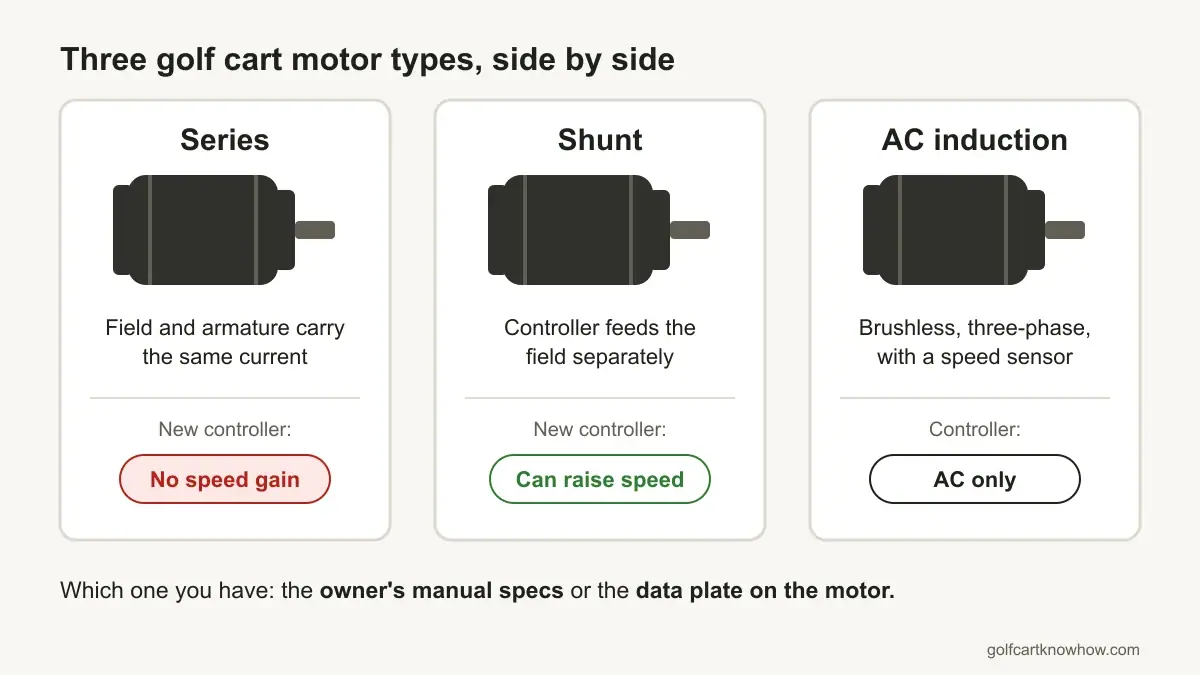
At a glance
- Three types: series DC on the oldest carts, separately excited (shunt) DC through the 2010s, AC induction on current ones.
- A controller swap: raises speed on a shunt motor, never on a series motor.
- Check first: batteries, cables, solenoid and speed sensor come before the motor.
On this page (5)
What kind of motor is in my cart?
Your own answer is in two places: the specifications page of the owner's manual, and the data plate on the motor itself. The table below covers what the cart makers print for current models.
| Cart | Years | Motor type | Rating |
|---|---|---|---|
| E-Z-GO TXT 48 Fleet | 2014 on | 48 V DC shunt wound | 3.0 hp continuous |
| E-Z-GO Valor | 2024 on | 48 V AC | 4.4 hp continuous |
| E-Z-GO RXV ELiTE | 2024 on | AC induction | not published |
| E-Z-GO Express S2 and S4 ELiTE | current | AC induction | 11.7 hp peak |
| Yamaha Drive2 PowerTech AC | 2027 | 48 V AC | 6.7 hp |
| Club Car Onward, flooded lead-acid | current | DC | 3.3 hp rated |
| Club Car Onward, lithium | current | AC | 4.7 hp rated |
| Evolution Classic 4 Plus | current | 48 V AC | 6.3 kW |
| ICON i40X | 2026 | 48 V three-phase AC | 5 kW |
Figures from the E-Z-GO, Yamaha, Club Car, Evolution and ICON specification pages and manuals. If your cart is older than these rows, the controller makers map the eras: an E-Z-GO Marathon, Medalist or TXT up to about 1994.5 has a series motor, and the DCS (1997 to 2001), PDS (2001 on) and TXT 48 (2010 on) cars have shunt motors, by Alltrax's own application guides. A Club Car built before 1996 is series; the Regen 2 and PD+ cars of 1997 to 2001 and the IQ cars from 2001 are shunt. A Yamaha Drive is DC through 2014 and AC from 2016, by the manual library.
Tip: Club Car's own pages disagree on the lithium Onward. The 4 Passenger page prints a DC controller; the 2 Passenger page, the Li-Ion sell sheet and the lithium page all print AC. Three to one: treat it as AC.
How the three types behave differently
If your cart has a series motor, a new controller will not make it faster: the field and armature carry the same current, so there is nothing for the controller to tune. With a shunt motor you get the opposite result, because the controller feeds the field separately and sets a field map that either tracks the armature current like a series motor or weakens the field so the motor turns faster. That is also why fitting a bigger controller of the same make changes nothing: the field map sets the speed, not the amp rating. A shunt cart will feel different once it is hot, as the field winding resistance rises.
If your cart is AC, the motor is brushless and three-phase, runs only on an AC controller, and carries a temperature sensor plus an external speed sensor at the end of the motor.
Regenerative braking is a controller function, not a motor type. On E-Z-GO speed-control carts the motor returns power to the pack downhill and when you lift off the pedal, and E-Z-GO is clear it is not a substitute for the brake. With a full pack your cart will barely regen on a descent, because the controller has nowhere to put the energy (Navitas). A lithium Onward lets you pick a regen mode on the display.
Is the motor actually the problem?
Usually not. Work through the batteries, cables, solenoid and speed sensor before you touch the motor, which is the order the controller makers use, and test the motor for short circuits before you buy a controller (Navitas). The signs that do point at the motor are tied to one controller family each:
- Curtis 1268, code 1,5 motor stall: too steep a slope, a mechanically locked motor, EM brake wiring, or a defective speed sensor.
- Alltrax XCT, 1 green and 5 red flashes: motor field failure.
- Alltrax SR, cart runs slow: a steady amber LED at full throttle points at the motor; a fast-blinking amber points at the solenoid and pack.
- Navitas TAC 2: a bad or damaged motor is one cause of a slow cart; crossed sensor wires or loose motor cables cause a stutter.
No maker publishes a motor lifespan or brush wear limit, but they do print what damages one. Holding the cart on a hill with the pedal, or leaving the motor stalled for more than 3 to 4 seconds, causes permanent damage (E-Z-GO), and towing without the Run/Tow switch in Tow damages the controller or motor. Tow an Evolution with the motor brake still locked and you ruin the motor, differential and brake.
The only printed motor interval is anti-seize on the Valor's motor coupling at 20,000 amp hours or 5 years. Removing or bench-testing a motor is a job for a qualified technician. The controller page carries the full code lists.
Should you upgrade the motor?
In most carts the stock motor is already enough, by Alltrax's own count of its customers: roughly 75 to 80 percent. Answer yes to any of its five questions and it is not: very hilly ground, more than three people, hauling or towing, a real speed increase wanted, or tires over 22 inches.
| Terrain | Tires | Use | Controller | Motor |
|---|---|---|---|---|
| Flat, golf | Stock | Light | 300 | Stock |
| Moderately hilly, golf | Stock | Light to medium | 400 | Stock |
| Flat to moderate | Large | Light to medium | 400 | Stock |
| Moderate to very hilly | Large | Heavy | 400 or higher | Torque |
| Flat, driving | Large | Medium | 400 or higher | Speed |
| Flat to moderately hilly, utility | Stock | Medium to heavy | 400 or higher | Torque |
From the Alltrax selection guide, 2006. Bolting a big controller to a stock motor is the common mistake: you get more torque and more heat, and the motor will keep accepting current past its rating until it burns up. A high-performance DC motor is built for that heat, with larger brushes, thicker wire, stiffer brush springs and better thermal insulation.
A bigger motor also means your cart needs heavier wiring: cables of at least 4 AWG and a 200 A or larger solenoid (Navitas). If the cables or the motor are too hot to touch after a run, the application is too demanding for what is fitted.
Going AC means a matched controller: Navitas requires its TAC 2 for TXT and Precedent conversions, and Alltrax offers the AC1 for TXT 48, PDS, DCS and Precedent cars. How much speed each change actually buys is a separate question.
Tip: Check the warranty before you order. Club Car excludes modified carts, ICON voids its warranty on speed-raising changes, and E-Z-GO will not approve conversions to 20 mph or more. Navitas warrants 24 months on factory settings that assume 18 inch tires, a non-performance motor and a 25 mph limit.
Common questions
Can I turn regenerative braking off on my golf cart?
Not as a simple on/off switch on most carts. E-Z-GO's TXT 48 lists programmable regenerative braking, and Club Car's lithium Onward has adjustable regen modes on its display. Changing those settings is dealer or programmer work.
What does "Regen" mean on an older Club Car?
It is the name the aftermarket uses for Club Car's late-1990s shunt-motor system. Alltrax lists Regen 2 and PD+ cars from 1997 to 2001, with a GE controller and a 23-pin connector, between the older series cars and the IQ cars from 2001.
Does an electric golf cart motor need servicing?
There is nothing to open up. What you can check yourself is the cable connections at the motor terminals, and whether the motor is too hot to touch after a hard run: Navitas treats that heat as a sign the cart is being asked for more than the motor and cables can take.