Your cart stops a little later than it used to, or it inches forward with the parking pedal latched, and every forum thread tells you to adjust the shoes. On nearly every golf cart the rear drums adjust themselves, so there is no routine adjustment to make. Your job is testing them, and knowing where to stop.
Golf Cart Brakes: Checking, Adjusting and the Parking Brake
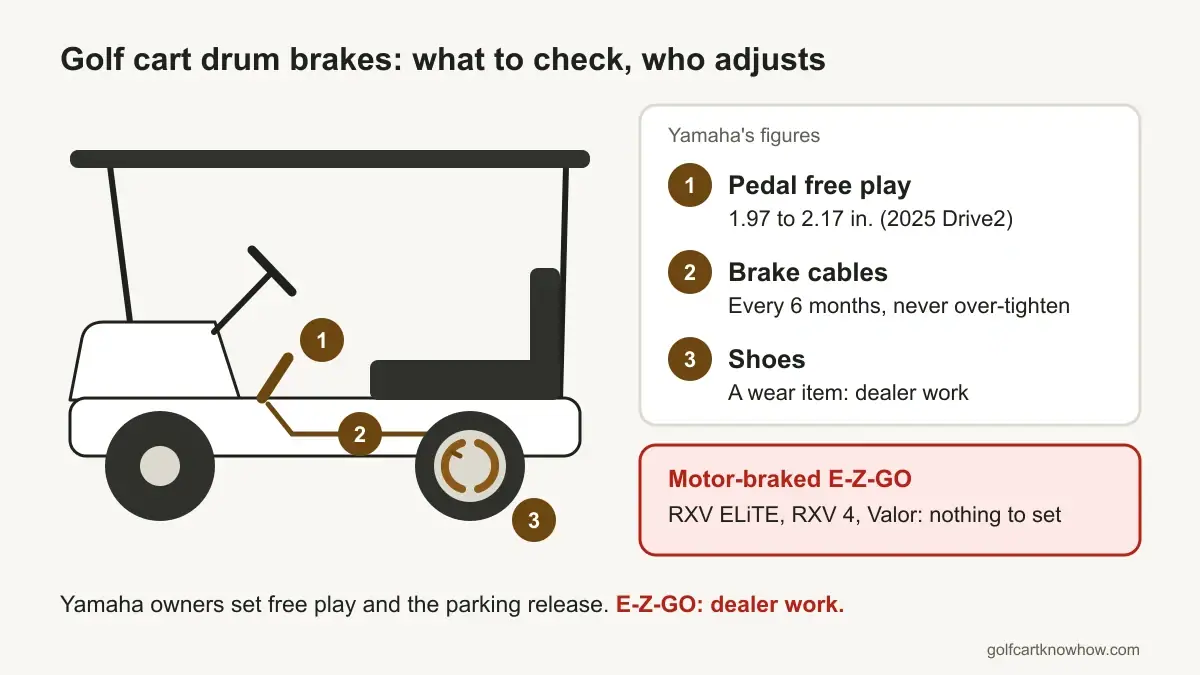
At a glance
- Nothing to adjust: the rear drums on nearly every cart are self-adjusting, so no routine shoe adjustment exists.
- Your job is the test: a firm pedal, a parking brake that clicks and holds, and a stopping distance you compare against.
- Only Yamaha prints an owner adjustment: pedal free play and the parking brake release, with figures that changed by model year.
On this page (5)
Which brake system does your cart have?
Before you touch anything, find out whether your cart stops with drums or with its motor. The newer electric E-Z-GOs have no service drum brake at all, so there are no shoes to inspect even when a chart says there are. Your own cart's line is in the specification table at the back of its manual.
| Cart | Service brake | Parking brake |
|---|---|---|
| E-Z-GO TXT and RXV gas | Dual rear mechanical self-adjusting drum | Foot pedal on the brake pedal; TXT releases on the lower part of the pedal, RXV on the accelerator |
| E-Z-GO TXT 48 electric | The same rear drums | Foot pedal, automatic single-point release |
| E-Z-GO RXV ELiTE, RXV 4, Valor | Induction motor | Automatic electromagnetic IntelliBrake |
| E-Z-GO Express S2 and S4 ELiTE | Dual rear drum | Automatic electromagnetic |
| Yamaha Drive and Drive2, gas and electric | Rear drums with self-adjusters, leading and trailing shoes | Foot pedal with automatic release |
| Club Car Onward and Tempo | Self-adjusting rear wheel mechanical drum | Foot pedal, 3-position on the Onward, multi-lock on the Tempo |
On the motor-braked E-Z-GOs, braking is the regenerative braking you feel when you lift off the accelerator plus the IntelliBrake, which E-Z-GO reserves for qualified personnel. A Valor or ELiTE owner adjusts nothing and calls the dealer.
Tip: The Valor manual contradicts itself. Its specification table lists the service brake as an induction motor, and its maintenance chart still carries a monthly brake-shoe row to inspect and replace as needed. There are no shoes to inspect on that service brake.
How to check the brakes and the parking brake
Yamaha's pre-ride check takes a few seconds: the brake pedal should feel firm and spring back when you let go, and the parking pedal should lock with a positive click and release when you press the accelerator. Press the brake pedal several times before you drive off.
E-Z-GO's periodic brake test is the one that catches a slow loss of stopping power, and it works because you compare against your own cart:
- Pick a dry, level, clean paved area clear of people, and mark a line.
- Accelerate to full speed and latch the parking brake at the line, not the brake pedal.
- Mark where the cart stops. Set this baseline when the cart is new, because no stopping distance is published.
- If a later stop lands more than 4 ft (1.2 m) past the baseline, or the cart pulls to one side, run the test again.
- A second failure means the cart comes out of service until a qualified technician has inspected it.
On a TXT 48 electric, E-Z-GO adds a monthly roll-down check: let the cart roll down an incline with the accelerator released, and braking should come in at about 2 mph. If the speed keeps climbing, use the service brake and book a trained mechanic. The brake rows in the rest of the maintenance schedule are short: E-Z-GO inspects shoes and tests parking brake performance monthly, oils the linkage rods, latch arm and catch bracket every three months but never the cables or the latch, and cleans and adjusts the brakes yearly. Yamaha checks the cables every six months, adjusts the parking brake release yearly, and treats shoes as a four-year dealer item.
The one adjustment a maker prints: Yamaha free play
E-Z-GO prints no brake adjustment steps for owners at all, because its drums are self-compensating, and Club Car's owner's manuals sit behind a dealer login. That leaves Yamaha. The figures below are from the 2025 Drive2 manual, gas and electric; use the manual for your own model year.
Turn the main switch OFF first, because accidental starting can move the cart. If a job takes a wheel off, chock the others, use jack stands and never a jack alone, and put the lug nuts back to torque: 74 lb·ft on 2025 Yamahas, 65 ft·lb on 2016 to 2018, and 65 to 85 ft·lb in a cross pattern in 20 ft·lb steps on E-Z-GO.
- Press the brake pedal with two fingers, light force, and measure the travel before you feel resistance: 50 to 55 mm (1.97 to 2.17 in.).
- Lift the floor mat and take off the service lid.
- Loosen the lock nut, turn the adjusting nut in or out until the travel is in range, then tighten the lock nut. Do not over-tighten the cables: that wears the brakes early.
- With free play set, press the parking pedal to the first latch position on the sector.
- Loosen the locknut, turn the bolt counterclockwise until it touches the sector, then clockwise one third of a turn (120 degrees) and tighten the locknut.
Tip: The free-play figure drifted. The 2016 Drive calls for 20 to 25 mm, the 2017 and 2018 Drive2 manuals leave the line blank, and the 2025 Drive2 asks for 50 to 55 mm. One edition's figure is never safe on another model year.
Worn shoes, and where the work goes to a shop
No maker prints an owner procedure for replacing shoes or drums, and none publishes a lining thickness or drum diameter, so there is no figure to measure against in your garage. Yamaha lists shoe inspection, adjustment and replacement as dealer or qualified-mechanic work with the steps in the Service Manual, and names shoes as a wear item, warranting brakes excluding shoes for four years. E-Z-GO's charts say inspect and replace as needed with no steps and tell you to let a certified dealer do work you are not familiar with. Club Car warrants brake cluster assemblies and cables for two to three years and voids the warranty on a modified braking system.
So shoes, drums and anything that changes how the cart stops are a job for a dealer or qualified mechanic. On a motor-braked ELiTE, the manual IntelliBrake release is for qualified trained personnel only and the cart moves at once if it is not on level ground; if yours will not release, start with the checks for a cart that will not move. Two operating facts close the loop: a load in the back lengthens your stopping distance, and the speed control system is never a substitute for the brake.
Common questions
Why does my golf cart roll with the parking brake on?
On a foot-latch cart such as a TXT, a Drive2 or an Onward, the pedal may not be reaching its full catch, or the park brake has lost performance. E-Z-GO's answer is the monthly parking brake performance test and a yearly clean and adjust; a cart that still creeps goes to a technician.
What would make golf cart brakes lock up or drag?
On a drum cart, over-tightened brake cables are the cause the makers name, and Yamaha warns they wear the brakes early. A cart that pulls to one side has failed E-Z-GO's brake test and belongs with a qualified mechanic rather than in the driveway.
Does an electric golf cart have brake shoes?
Some do. A TXT 48 electric and an Express S2 or S4 ELiTE stop on rear drums with shoes, while the RXV ELiTE, RXV 4 and Valor list the induction motor as the service brake with an electromagnetic parking brake. The specification table in your manual settles it.