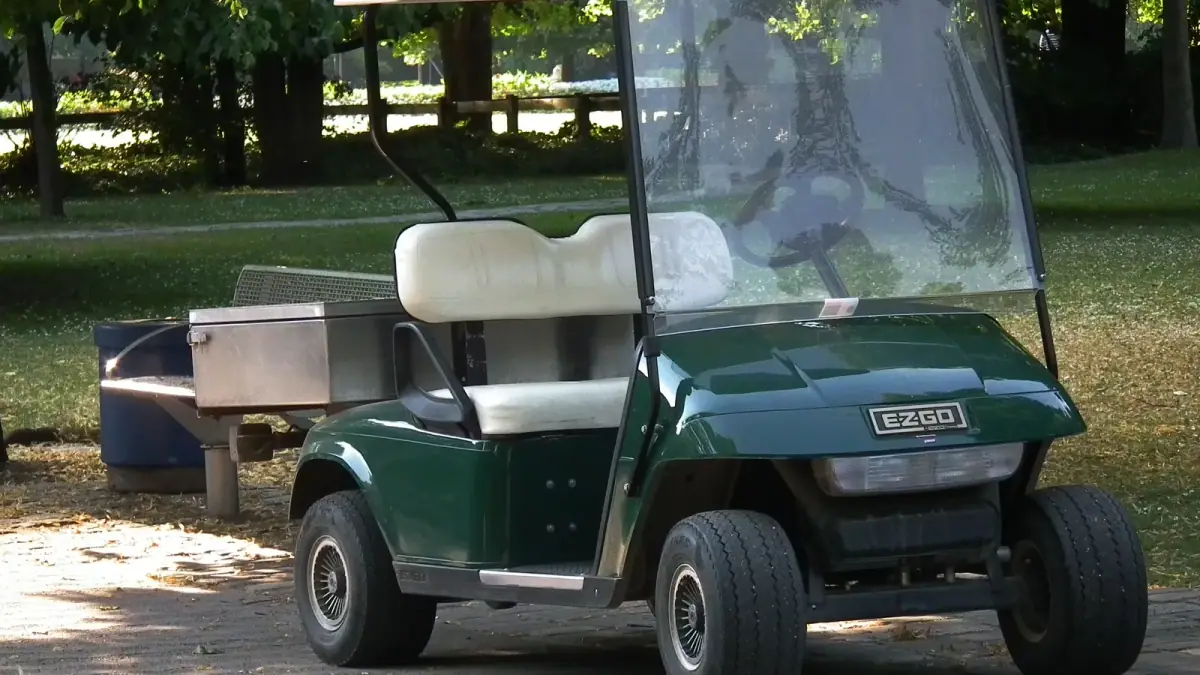
You are standing next to a cart that says E-Z-GO on the side and nothing else useful. Almost every used one is a TXT or an RXV, with older ones badged Medalist or Marathon, and Freedom is a trim on both, not a model. You can tell which by eye, then read the year off the serial plate.
E-Z-GO Golf Carts by Year: TXT, RXV and the Older Models
At a glance
- Two lines cover most carts: the TXT and, from 2008, the RXV.
- Quickest tell: a TXT has a foot park brake on the pedal; an electric RXV sets its own brake when it stops.
- Year: the last two digits of the manufacturer's code, though it can mislead.
On this page (5)
Which E-Z-GO do I have?
Start with the parking brake, because it splits the lineup fastest. Press the top of the brake pedal: if a foot park brake locks down and releases when you hit the lower part of the pedal, you have a TXT or a gas RXV. If nothing locks and the cart holds itself the moment it stops, it is an electric RXV with IntelliBrake.
Then look at the rest:
- TXT: plastic body, sloped cowl, charger socket on the panel below the driver seat, direction selector on the seat wrap panel, a separate key switch on the dash.
- RXV: one four-position key switch on the dash that also selects forward and reverse, charger socket on the front wall of the seat, vertical taillights.
- Medalist and Marathon: metal body with a black plastic nose cap. The Marathon has two separate seat backs, the Medalist one.
- Gas: a fuel filler and a fuel gauge or warning light on the dash, no charger socket.
- ELiTE lithium: one battery module under a cover with a warning label, and a charge meter reading in percent rather than F to E.
Quick tell: look at the state of charge meter beside the key switch. F to E means a lead-acid TXT. A percentage with a LOWBAT warning, which doubles as a speedometer, means a lithium RXV.
Reading the year off the plate
- Find the plate. On a TXT it is inside the passenger-side glove box, or on a sticker under the seat on the frame rail. On an RXV, look on the frame at the rear passenger side, or near the base of the steering column on later carts. Pre-1976 carts have it under the driver seat.
- Ignore the six or seven digit serial number. It does not carry the year.
- Read the manufacturer's code: a letter and three or four digits. Parts retailers read the last two digits as the model year, so K1488 is the 14th week of 1988.
Treat that as a strong hint, not proof. GolfCartStuff warns that E-Z-GO changed its coding several times and built two models in the same years, so the code is often unreliable. On 1976 to 1978 carts the year is the first two digits. If the year decides a purchase, have a dealer check it against the serial number.
E-Z-GO models by year, voltage and drive
Years for the older lines come from parts retailers, since E-Z-GO itself publishes no start dates and hosts manuals only for current models. Treat them as approximate.
| Model | Years | Power | Voltage and drive | Known for |
|---|---|---|---|---|
| Marathon | 1975 to 1993 | Electric or gas | Resistor or series DC | Metal body, separate seat backs |
| Medalist | 1993 to 1999 | Electric or gas | DCS or series DC | Metal body, black nose cap |
| TXT 36 V | 1995 to 2009 | Electric | 36 V, DCS then PDS | Cheap parts, huge aftermarket |
| TXT 48 V | 2010 on | Electric | 48 V, six 8 V batteries, shunt DC | Body redesigned for 2014 |
| TXT EX1 | 2020 on | Gas | 150 cc, 11.5 hp, CVT | Fuel injected, no choke |
| RXV 48 V | 2008 on | Electric | 48 V AC drive, four 12 V batteries | IntelliBrake, regen braking |
| RXV ELiTE | Current | Electric | 48 V AC, one Samsung lithium module | No watering, dealer-only pack |
TXT vs RXV: what a used buyer should know
The TXT is the simpler cart. Its electric version uses a DC motor and rear mechanical drum brakes, with that foot park brake on the pedal. Parts are everywhere and cheap, and a 36 V or 48 V TXT takes almost any aftermarket motor, controller or lithium conversion kit you point at it.
The RXV drives better and asks more of you. E-Z-GO's AC Drive gives it regenerative braking: lift off the pedal and the motor slows the cart and sends power back to the pack. IntelliBrake then sets the parking brake automatically every time you stop, and holds on a grade.
That automatic brake is the catch when buying used. You cannot simply push or tow an RXV: the key goes to N and the run/tow switch to TOW before the wheels will roll freely. On a dead cart that switch may not respond, and the manual release under the controller splash shield is a job for a trained technician, since the cart will move immediately if it is not on level ground. Check the tow switch works before you hand over money.
Before you buy: ask whether the open recalls were done. The 2021 to 2023 carts with the optional USB port had a dealer-fitted thermal sleeve, and gas TXT and RXV carts from 2020 to 2025 need a fuel line inspection.
Each line, good and watch-out
- TXT. Good: the easiest E-Z-GO to keep running, with parts and upgrades for every year. Watch out: 2012 to 2013 carts had a steering wheel nut recall, and 2021 TXT-chassis carts a parking brake bracket recall.
- RXV. Good: AC drive, hill holding and, on lithium carts, a maintenance-free pack. Watch out: 2022 to 2023 carts had a steering knuckle and A-arm recall, and the lithium pack is dealer-service only.
- Medalist and Marathon. Good: cheap and mechanically simple. Watch out: metal bodies rust, and these years have no decoding you can rely on.
For 2027 E-Z-GO lists the RXV 2, RXV 4, Liberty 4, Liberty 4F and Express 6, with Valor and Freedom as RXV trims. The TXT appears on no current model page, though E-Z-GO has never said it was discontinued, so treat it as a used-market cart rather than a dead one. If a Club Car Precedent is also on your list, compare its lead-acid pack layout and ask the same questions about lithium against lead-acid before you choose.
Common questions
Is an E-Z-GO TXT 36 or 48 volts?
Both exist. Parts retailers list 36 V TXT carts with DCS or PDS drive from roughly 1995 to 2009, and 48 V shunt-wound TXT carts from about 2010 on. Count the batteries under your seat: six 8 V batteries is 48 V.
What does PDS mean on an E-Z-GO?
PDS and DCS are names parts retailers use for the two older 36 V TXT drive systems. On a PDS cart the forward and reverse switch is on the dash; on a DCS it sits below your knees. E-Z-GO's own manuals use neither term.
Does E-Z-GO still make the TXT?
The TXT is not on E-Z-GO's 2027 personal or fleet model pages, and the company's used-cart program covers the RXV. Its owner's manuals page still carries TXT 48 V and EX1 gas manuals, and E-Z-GO has not announced any end of production.